By Mohammed Tafraouti
In the framework of the TransforMed program, a Mediterranean scientific initiative aimed at building sustainable and climate-resilient agroforestry systems, a series of field visits was launched across Morocco’s leading agricultural sites. From Khemisset and Meknes to Essaouira, Agadir, and Aït Baha, each stop reflected the diversity of experiences and the richness of local practices.
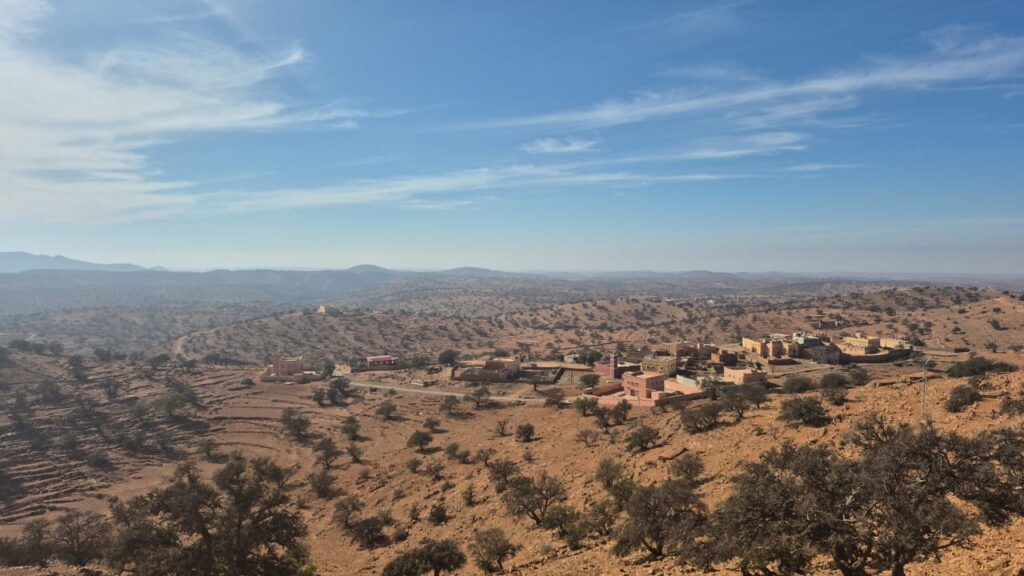
At the heart of this landscape , the province of Chtouka Aït Baha, ascending towards Hillala, or more precisely Illalen (its authentic Amazigh name as preserved in oral tradition) in the Anti-Atlas Mountains, became the stage of a scientific and media journey rich in symbolism and meaning.
The final leg of the journey, reaching 1,265 meters above sea level, was both a climb through rugged terrain and a descent into the memory of the land, landscapes guarded by resilient trees, and faces imbued with the scent and stories of the land.
The Road to Hillala (Illalen): A Return to the ancient Time
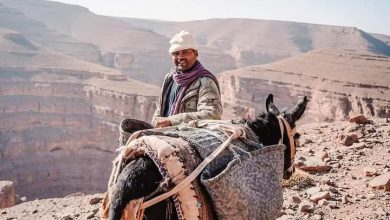
Departing from the city of Agadir, the team, composed of researchers and communication specialists, ventured through winding rough mountain trails. ” These were the very paths once traversed by villagers decades ago, when donkeys and mules were the only travel companions, and the mountains stood as silent sentinels to their journeys.
Every turn tells a story of endurance. Despite the harshness of nature, the scarcity of resources, and the austerity of life, the inhabitants of these mountains have remained steadfastly attached to their land. For them, the lan is identity, and the argan tree, a source of livelihood, a cradle of biodiversity and culture, and a foundation for social and economic development.
Trees on the Edge of Life
Along the path leading to Aïcha’s house, argan trees appeared in varied states, some lush and full of promise, others withered and weary from a drought that has persisted since 2017. Yet faint signs of renewal could be seen following the limited rains of 2024.
Ahmed Oussyad, President of the Interprofessional Federation of the Argan Sector, welcomed the delegation with a hopeful smile. “Despite the harsh drought, the coming October will bring the promises of making up for years of scarcity.”
Aïcha’s House: Craft and Identity
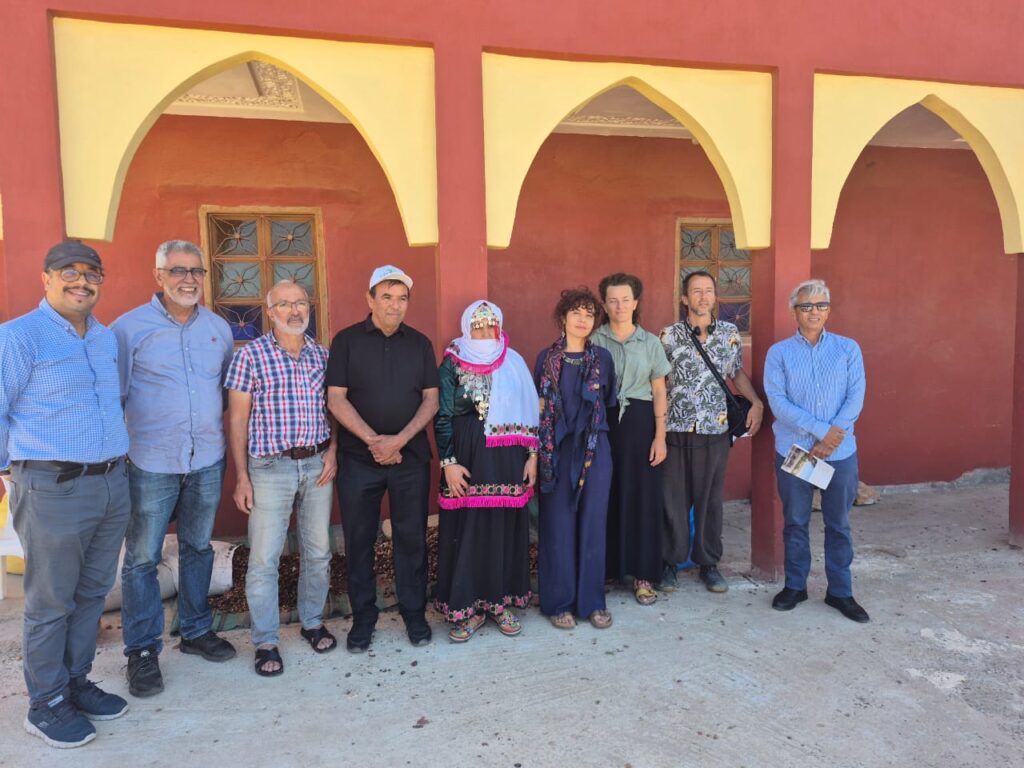
In a spacious courtyard surrounded by mint and basil, Aïcha Ajkour, president of the Tadaskout Cooperative, sat gracefully in her traditional Amazigh dress, adorned with engraved silver jewelry bearing ancient motifs.
With the dexterity of an experienced craftswoman, she cracked argan nuts after peeling them, the bag filled with argan fruit “Afiyash” beside testifies her daily perseverance in transforming the kernels into precious oil. Her conversation with visitors revealed the trials of her craft: drought, marketing challenges, and the impact of the pandemic on the sector. Yet her words radiated belonging and resilience. “Argan is not just a tree,” she said softly. “It’s our life.”
Ahmed Oussyad: The Voice of Associations and Guardian of Heritage
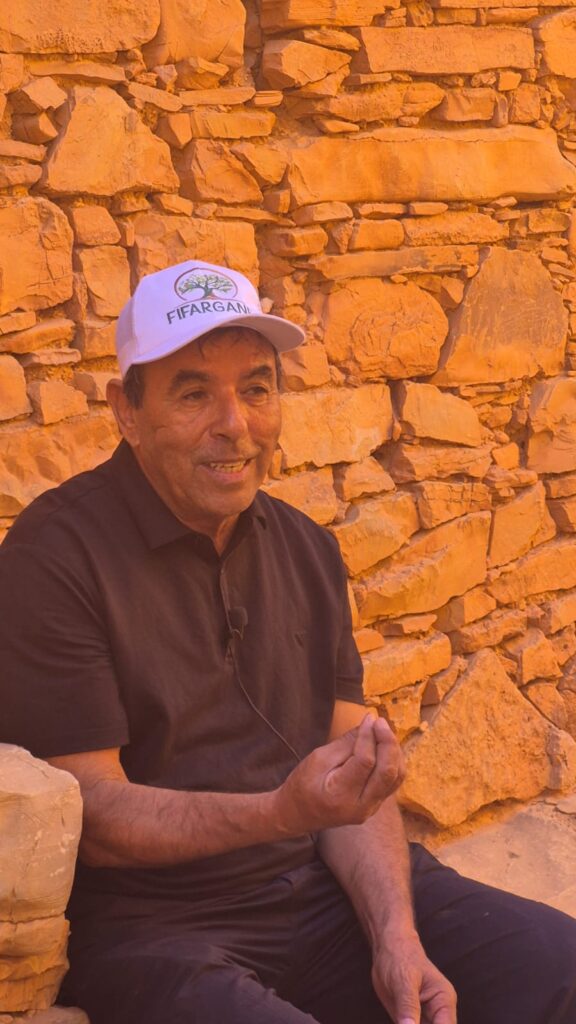
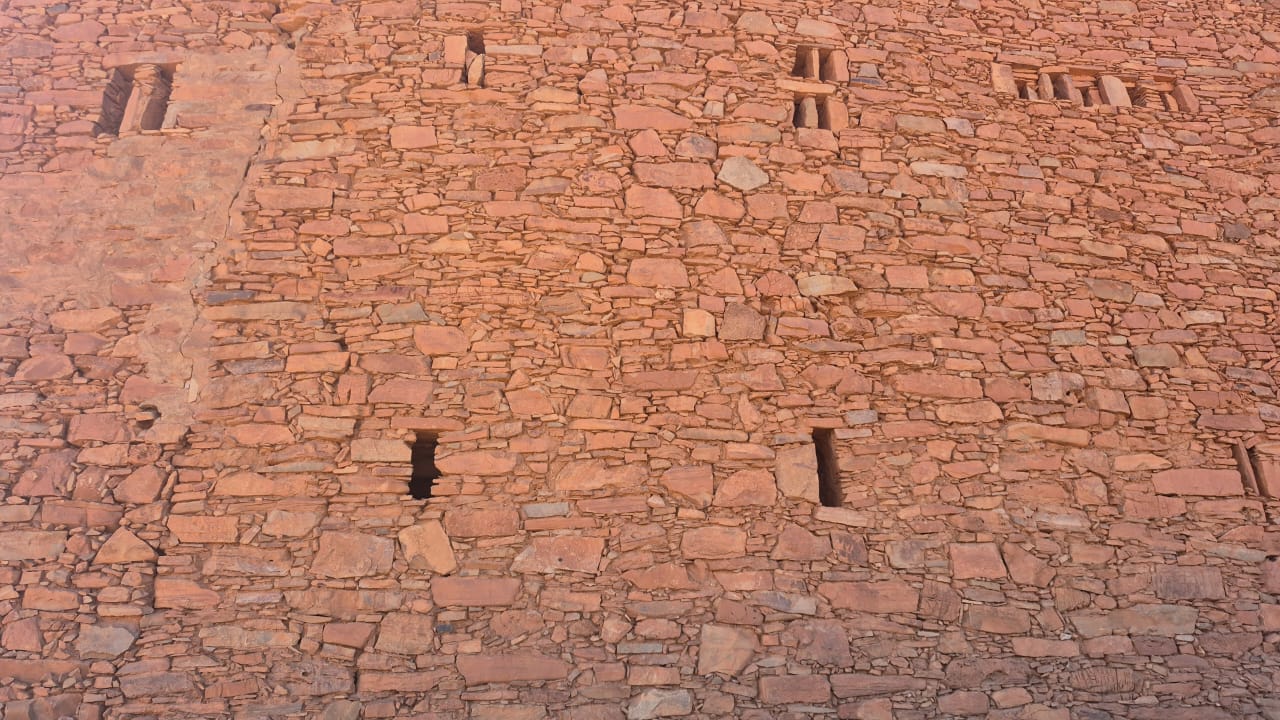
At the center of this field scene stands Ahmed Ousiad, president of the Interprofessional Federation of Argan sector, a figure as deeply rooted in the land as the tree itself. Moving passionately between farmers, researchers, and institutions, he led the visitors through the paths and relics of the ancient fortress and communal granary, pointing proudly to the school where he once studied and to the silent ruins of a mosque that once resonated with children’s voices and prayers.
There, in the heart of the mountain, rests the communal granary that once safeguarded the provisions of 164 families, watched over by a custodian known as l’Amine under strict local customs, and by cats that were themselves fed from the stored goods. When the old iron-clad door creaked open, echoes of the past filled the air, the call to prayer rising from the nearby mosque, the murmur of men depositing or retrieving supplies, and the rhythmic clatter of wooden and iron locks composing the music of the place.
The granary’s traditional architecture has withstood seven centuries, a living testament to a mountain civilization that defied time and transformation.
Agadir n’Toubkal: The Shadow of Argan and the Fortress of the Tribe
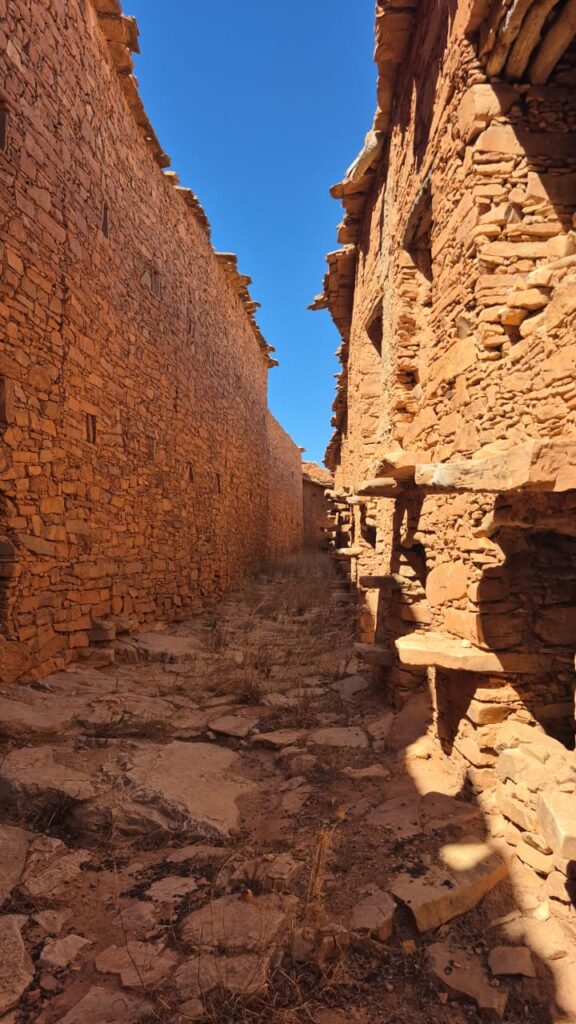
Amid the silent corridors of the now-empty communal granary Agadir n’Toubkal, where stillness and wind engage in an eternal dialogue, the scene resembled a wordless architectural manuscript, history written on stones. Every wall bore the tattoos of centuries, every corner retained the shadow of a departed inhabitant.
Originally, “Agadir n’Toubkal” derives from the Amazigh Agadir Toug Akal, “the granary overlooking the land”, a name later simplified to Toubkal, denoting the highest point overlooking the rest of the land.
When Ahmed Oussyad, descendant of one of the tribe’s ancient families, opened the doors of time, I felt as though stepping into a living memory. Proudly, he guided us between the rows of storerooms, each with its own unique door and lock. Before his family’s chamber, he recalled every detail, from food supplies to old documents and wooden tablets. Every step between these rooms was a passage through time; every lock, a tale of trust, solidarity, and communal memory preserved across generations.
Stones That Pray and Plants That Persist
As I wandered through the ruins of the fortress, I felt my sense of belonging reawaken. Passing through the granary’s gate, I was no longer an outsider but a returning descendant, as if joining my ancestors at their table. I didn’t pay attention to the companion or friend accompanying me, nor did I even talk to myself.
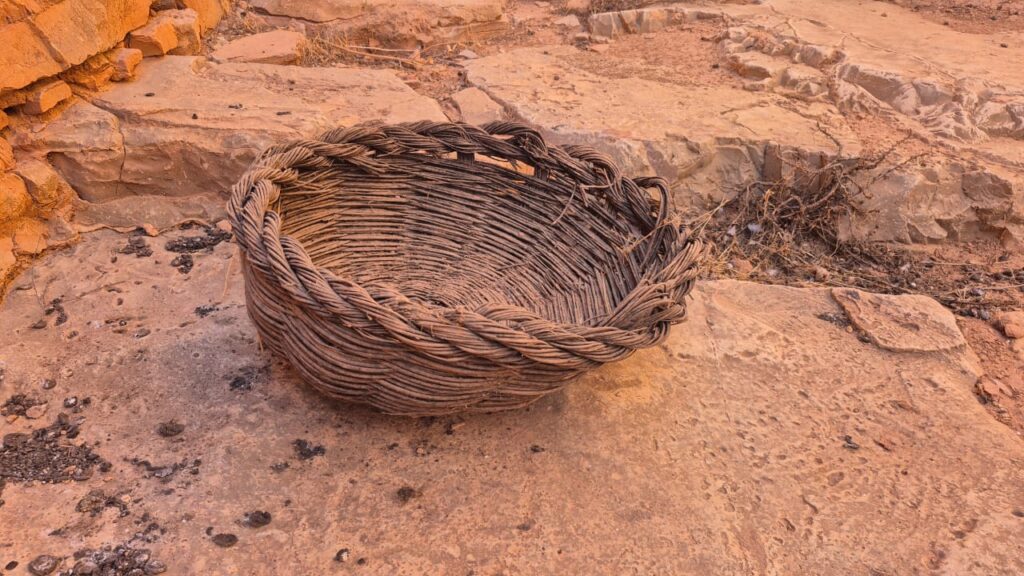
Everything around me spoke: the carefully stacked stones like a long stony prayer, the scattered objects whispering stories, a torn shoe halted mid-journey, a palm-fiber plate recalling an unfinished family meal, the skeletal remains of a cat bearing witness to countless battles for survival.
And there, between the cracks of the rocks, rose a defiant plant known in Amazigh as Tinnert , reaching upward, insisting on life amid emptiness and decay. Together, the remnants of tools, stone, and vegetation seemed to declare: “We are still here. Life endures.”
The Question of Knowledge and Survival
Breaking the contemplative silence, researcher Abderrahmane Ait LHaj asked earnestly: “Why do these ingenious and efficient ancestral pratice remain so underutilized today, despite their strategic and life-sustaining value?”. His question hung in the air, as if the granary’s walls themselves joined the conversation, about knowledge, sustainability, and the wisdom of those who lived here for centuries. The silence was eloquent, a silence that told, in the language of walls, the story of a civilization that refused to die, persisting in the memory of the place.
Argan: Between Science and Traditional Knowledge
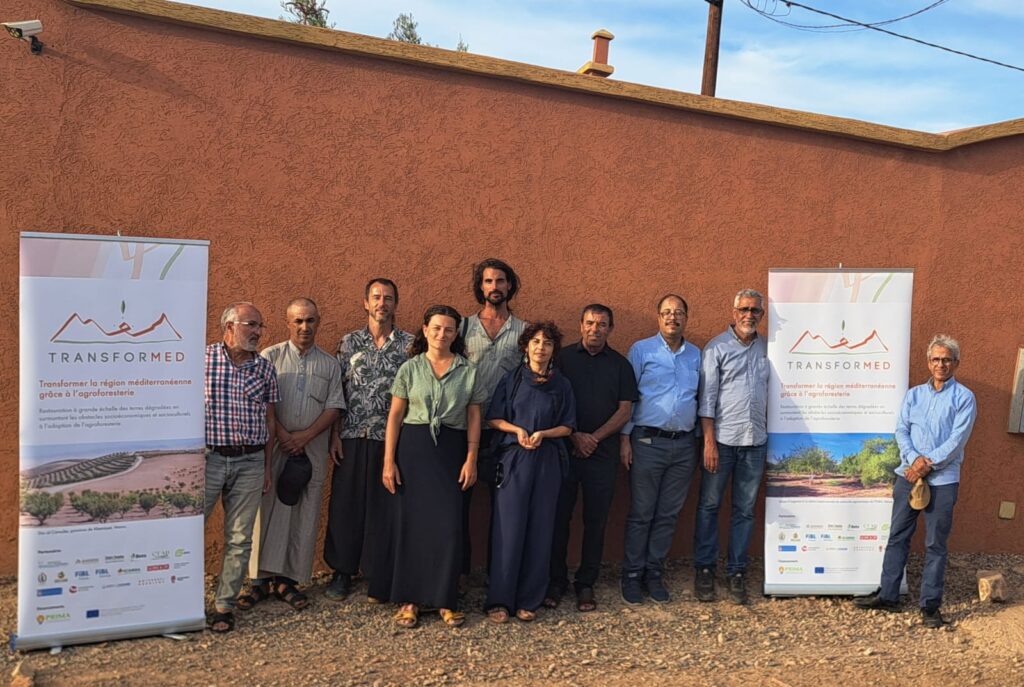
The TransforMed project, funded by the PRIMA program and coordinated in Morocco by the AGENDA Association in partnership with the National Agency for the Development of Oasis and Argan Zones (ANDZOA), seeks to build an institutional framework to enhance the value and preservation of the argan ecosystem, by integrating scientific research with the traditional knowledge of local communities. to promote agroforestry practices. For argan is not merely a tree, it is an integrated ecological, cultural, and economic system.
A Lesson from Hillala (Illalen)
The journey to Hillala (Illalen) was more than a field mission, it was a journey through the soul of a place where history and identity intertwine. Here, argan stands as a symbol of resilience and hope amid climate change and water scarcity, a bridge between past and present, between humans and their land.
From the heart of the Anti-Atlas, the promise is renewed: that argan will remain a witness to ancestral wisdom, a symbol of generational resilience, and a lever for a greener, fairer, and more sustainable future.