Juan David Escorcia and Irene Banos Ruiz**
Ships sail steadily thanks to tanks filled with ballast water. But when discharged in other ports, they release a vast number of microorganisms, larvae, and algae. Without proper treatment on board, these organisms become invasive species. An international agreement seeks to prevent this.
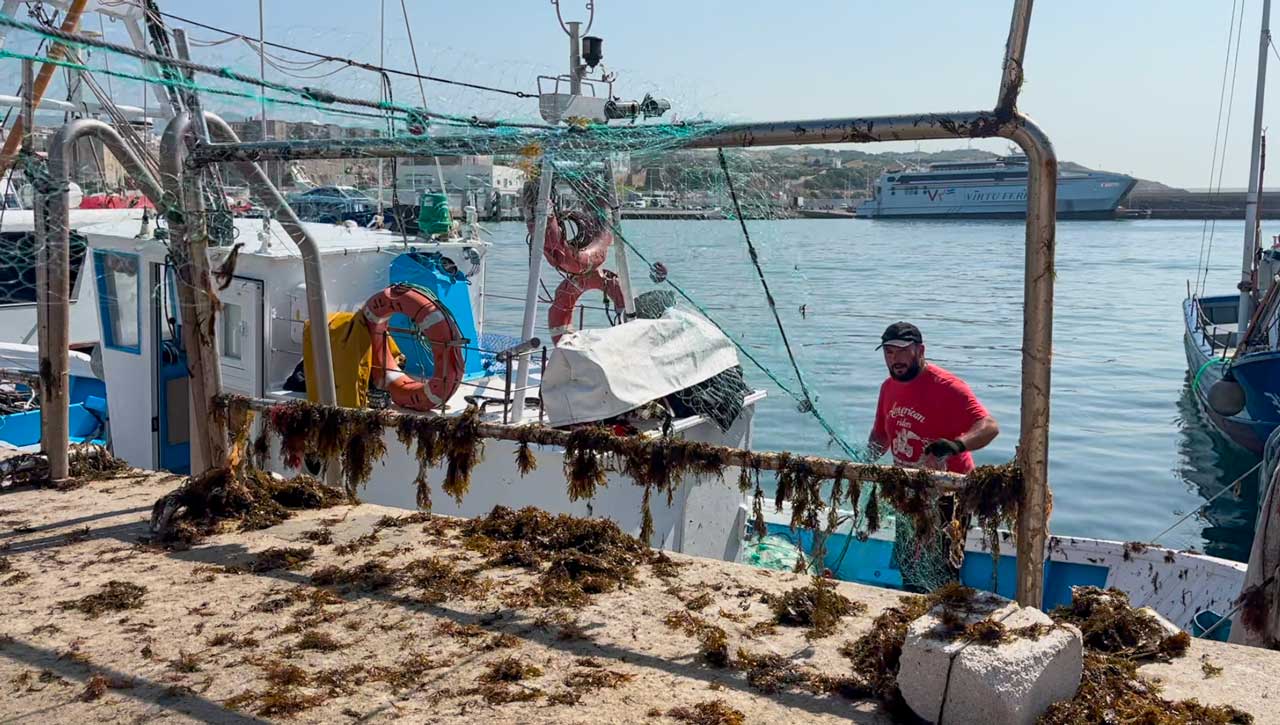
The boats of the Fishermen’s Association of Tarifa, at the southern tip of Spain, return from fishing trips loaded with nets full of the Asian alga Rugulopteryx okamurae. It is an invasive species that fishermen have been battling for ten years. They search through the brown mass for some fish to justify a day’s work, but what remains is only an acidic smell that ruins the atmosphere.
As with fishing boats, this alga also blankets the golden sands of Tarifa’s tourist beaches, extends along the coasts of Cádiz, and invades coastal areas in Málaga, raising fears it may reach the eastern coasts of Spain. This marine colonization has also spread to Italian, French, and Moroccan shores.
This invasive species was introduced in 2015 via ballast water tanks of ships arriving from the Pacific Ocean. In the Mediterranean, it found ideal conditions to thrive: the absence of natural predators, ease of dispersal by human activities or marine currents, and favorable temperatures. Although the Mediterranean represents only 1% of the world’s ocean surface, 30% of global maritime trade passes through its waters. This explains the arrival of Rugulopteryx okamurae amid increasing maritime traffic.
Manuel Suárez, president of the Fishermen’s Association, says: “This [Asian alga] came, as everyone knows, with the ballast water discharged by commercial vessels,” pointing to the tanks, while in the distance small containers appear stacked on the decks of ships crossing the Strait of Gibraltar.
An international agreement to curb invasive species
Concerns about invasive species entering oceans via ballast water first arose in the 1970s within the International Maritime Organization (IMO). This led the organization, in 2004, to adopt the International Convention for the Control and Management of Ships’ Ballast Water and Sediments.
Years of negotiations followed between countries, political powers, economic interests, and lobbying groups. In 2016, 30 countries representing 35% of global shipping tonnage ratified the convention. The number grew in 2017 to 60 countries, equivalent to 70% of the global merchant fleet at that time. With China’s accession in 2020, the percentage rose to 90%. The United States, however, still refuses to ratify, citing its own national regulations.
With Regulation D-2 of the convention entering into force in September 2024, signatory states must now require vessels to install certified ballast water treatment systems on board. Although 80% of the merchant fleet of signatory countries is already equipped, responsibility for verifying proper operation falls on port authorities. Yet port officers describe inspections as a race against time, and in ports such as Barcelona, complaints arise over staff shortages.
The sheer number of ships calling at global ports makes comprehensive inspections difficult, and ballast water checks are often delayed in priority. According to the IMO, inspections generally focus on three areas: safety of life at sea, prevention of marine pollution from ships, and crew training and certification.
“Ballast water is just one logbook that may or may not be inspected,” says Guillaume Drillet, director of global marine services at the inspection company SGS. Still, this year a special campaign was launched in ports to “inspect ships and ensure compliance with the convention.”
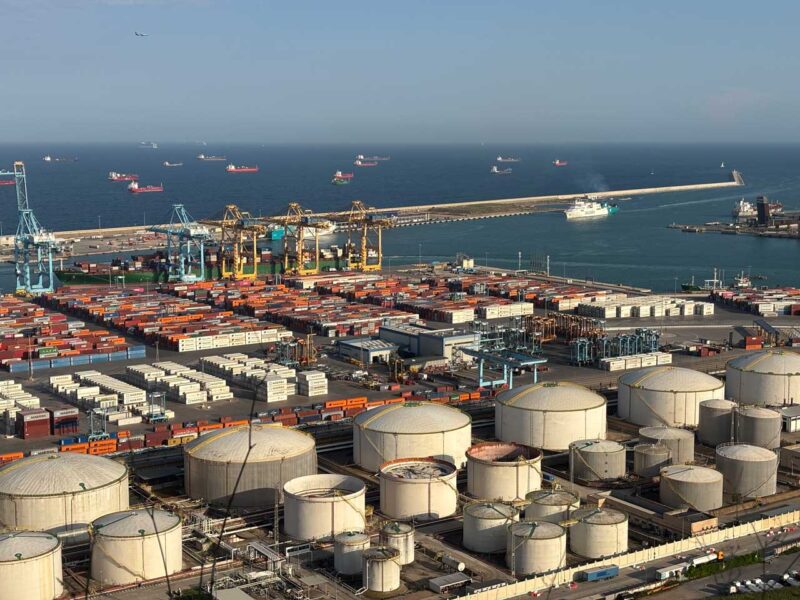
A panoramic view of maritime traffic awaiting entry into the port of Barcelona. Irene Banos.
Despite operational challenges faced by port authorities, the ParisMou platform compiles inspection data from Mediterranean ports. It records failures related to ballast water treatment systems, whether technical breakdowns, operational shortcomings, or maintenance issues.
Between September 2024 and July 2025, 58 detentions of ships in Mediterranean ports were linked to such systems. Half of the cases were due to errors in ballast water management records, 29% to maintenance failures, and 19% to crew unfamiliarity with the system. In Spain, however, only one detention was recorded during this period: a Liberia-flagged vessel in the port of Carboneras (Almería).
Italy and the absence of ratification
Among the countries that have not ratified the convention is Italy. According to Luca Castriota, a researcher at the Italian National Institute for Environmental Protection and Research (ISPRA), this absence leaves authorities “tied hands” when facing invasive species such as Rugulopteryx okamurae, which damaged Sicilian coasts two years ago.
Drillet adds that when a country has not ratified, its port authorities are “not entitled to inspect vessels calling there.” Nevertheless, Italian vessels must comply with the convention when docking at ports in ratifying states, consistent with the IMO principle of “no more favorable treatment” for non-parties.
A ship discharges ballast water in the port of Palermo, Italy. Irene Banos.
Castriota hopes Italy will soon ratify the convention, as it “imposes strict limits on the entry of exotic species.”
The issue of microns
“Regulation D-2 of the IMO convention requires controlling three types of bacteria in ballast water, mainly for health reasons,” says Javier Moreno, a researcher at the University of Cádiz. Thus, the agreement mandates neutralizing invasive species larger than 10 microns.
Yet controlling invasive species goes beyond health concerns to become an environmental priority. In this regard, organisms smaller than 10 microns remain outside regulation despite their danger, as they are the most harmful to marine ecosystems. Moreno explains: “The fraction smaller than 10 microns, which is the most important, is not controlled at all.”
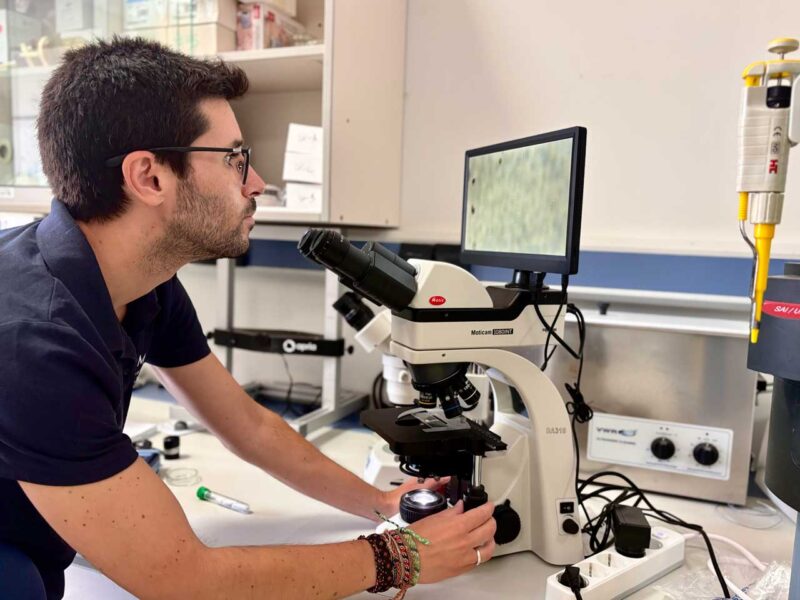
Javier Moreno analyzing ballast water samples at the University of Cádiz laboratory. Irene Banos.
Recent studies have shown that most failures of ballast water treatment systems are due to high concentrations of organisms larger than 50 microns, while bacteria, viruses, and algal spores can still survive and spread. It is a microscopic world traveling alongside merchant fleets on all their sea routes, including the Mediterranean.
Fishermen’s struggle
Meanwhile, far from international agreements, Tarifa’s fishermen spend five unpaid hours removing the Asian alga from their nets and boats. Some throw it back into the sea. A vicious cycle that, as Suárez says, represents “a turning point in the already fragile situation of fishermen.”
The frustration of small-scale fishermen intersects in the Strait of Gibraltar with the imposing sight of giant commercial vessels driving the Mediterranean region’s economy. Yet both share a common horizon: the need for effective ballast water controls to prevent the arrival of the next marine invader.
*Irene Banos is a multimedia journalist specializing in environmental and climate change issues.
*Juan David Escorcia is a multimedia journalist and podcast creator specializing in environmental and migration issues.
This article was first published in Climatica and produced with support from Journalismfund Europe