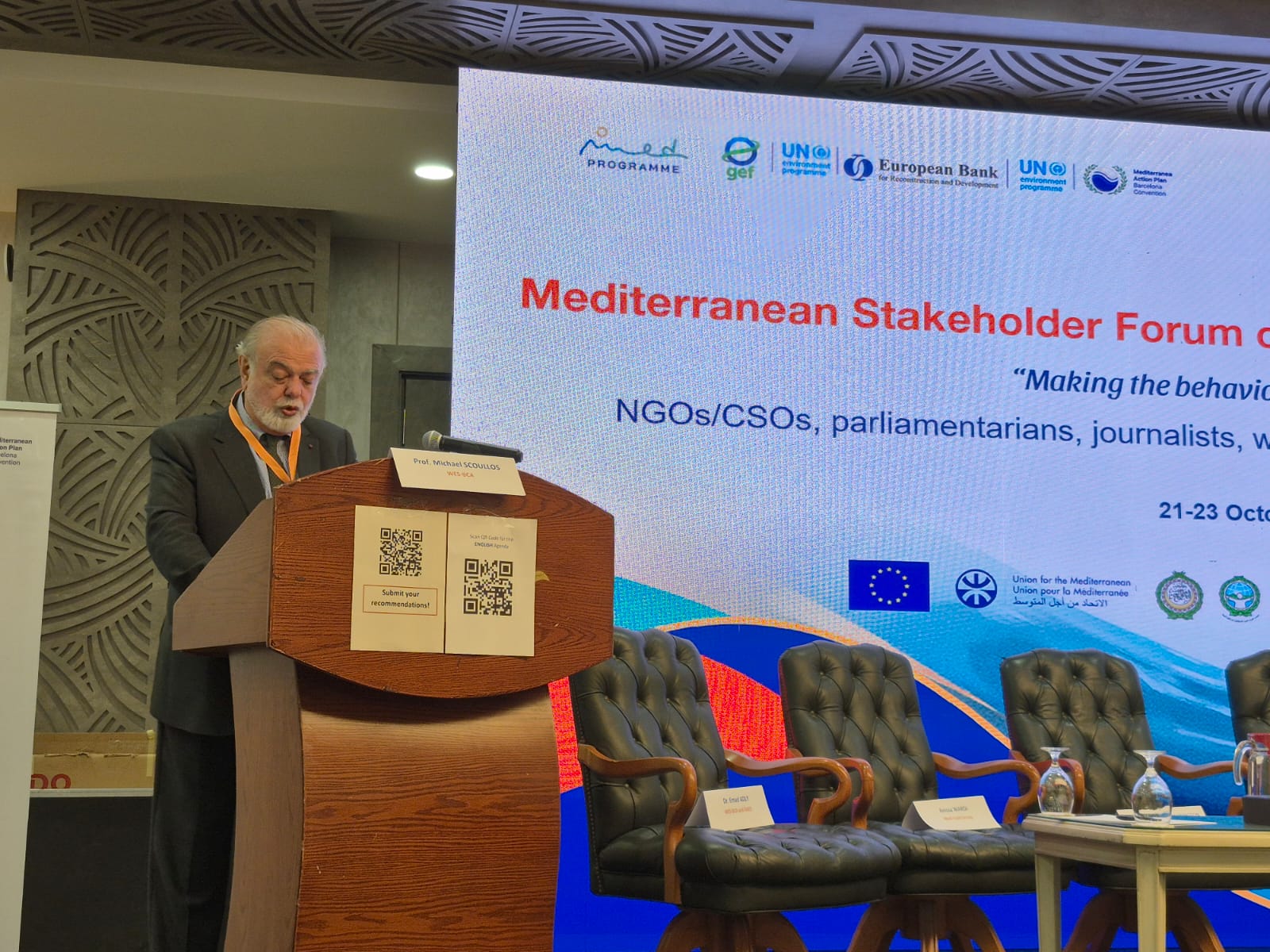
By Mohammed Tafraouti
Opening Speech by Prof. Michael Scoullos:A Call to Resist Apathy and Revive Hope for a Sustainable Future
In a powerful opening address at the Mediterranean Stakeholder Forum on Environment and Climate Action, held in Cairo from October 21 to 23 under the theme “Making the Behavioural Shift Happen”, Professor Michael Scoullos, Coordinator of the EU WES-BCA Project and Chairman of the Mediterranean Information Office for Environment, Culture and Sustainable Development (MIO-ECSDE), stressed that achieving a collective behavioural transformation has become an urgent necessity rather than a choice in light of the accelerating environmental and climate challenges facing the Mediterranean Basin.
Welcoming representatives of nearly one hundred organisations from civil society, parliaments, the media, and women’s and youth groups, Scoullos said: “It is my great pleasure to welcome you on behalf of the Mediterranean Information Office, the EU, and the UNEP Mediterranean Programme. This forum brings together regional actors to face the climate crisis that binds us all.”
He underlined that the climate crisis in the Mediterranean region is no longer a purely environmental issue, but one that deeply affects water, food, and social security. He explained that water scarcity, forest fires, biodiversity loss, and the spread of invasive species are interlinked symptoms of a profound and long-term crisis, one expected to persist for decades even with some progress in mitigation policies.
Scoullos also warned that these environmental transformations intersect with armed conflicts and humanitarian crises, which have eroded public trust in governance and deepened collective frustration.
He remarked: “Fatigue and despair push people toward indifference and short-termism, living only for today and consuming without thinking about environmental consequences.”
Drawing from personal experience, he recounted a telling encounter with a farmer in Greece who told him: “We have no future. I’ll take what I can now, my children have already left, and I don’t care anymore.”
For Scoullos, this reflects a loss of hope, vision, and a sense of responsibility toward future generations.
Turning to the media, he sharply criticized the role of some outlets in fuelling confusion, fear, and alienation: “Instead of serving as a platform for awareness and empowerment, media narratives too often reinforce despair and virtual detachment from reality. We must reorient communication toward hope, integrity, and responsibility.”
Yet, despite this sombre assessment, Scoullos insisted that the Cairo forum was not about surrendering to pessimism, but quite the opposite. He called for transforming challenges into opportunities through enhanced North–South cooperation in the Mediterranean, an area he described as “not a melting pot, but a beautiful mosaic of coexistence.”Our region’s strength lies in its diversity,” he said. “Through cooperation, we can turn crises into catalysts for change.”
He explained that the forum’s objective was to identify priority areas, coordinate efforts, and share good practices to empower local actors and rebuild citizens’ trust in their capacity to act. “We must restore courage and confidence among people,” he urged, “to overcome fatalism and work actively for their environment and their children’s future.”
Scoullos further highlighted the vital role of civil society organisations, parliamentarians, women, youth, academics, and journalists, describing them as “lighthouses” guiding societies toward sustainability: “Despite limited resources, they are driving real progress in awareness, advocacy, participatory science, and environmental restoration—often filling the gaps left by administrations.”
He concluded his speech with a heartfelt appeal to empower youth and rekindle hope: “We want to show our determination for hope. We don’t want to see our youth wither before they blossom. We want them engaged with us, in the field, away from virtual illusions, learning how to cherish this planet and be part of a movement that resists decay and restores life.”