by Mohammed TAFRAOUTI
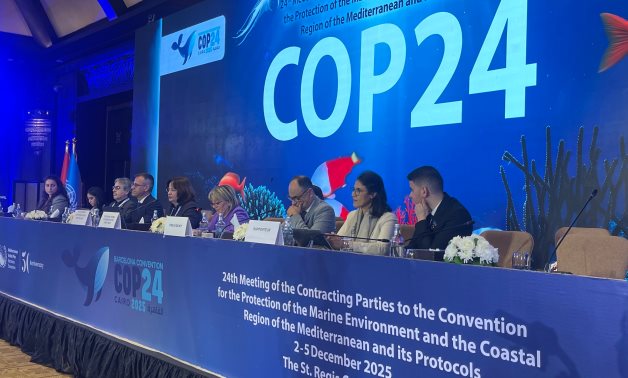
As environmental pressures on the Mediterranean Sea continue to rise at an unprecedented pace, the 24th Meeting of the Contracting Parties to the Barcelona Convention and its Protocols (COP24) was held from December 2–5, 2025, in Cairo, Egypt, under the theme: “Sustainable Blue Economy for a Resilient and Healthy Mediterranean Sea.” The summit brought together representatives from 21 Mediterranean countries and the European Union, alongside key stakeholders, to discuss ways to confront the region’s critical cross-border environmental challenges.
COP24 in Cairo: Challenges and Opportunities
Participants addressed urgent issues such as marine pollution, climate change, and biodiversity loss. Discussions focused on strengthening regional cooperation and promoting sustainable solutions to protect the Mediterranean’s unique ecosystems and advance the blue economy.
The Conference of the Parties is the highest decision-making body within the UNEP system and the Barcelona Convention. It provides a vital platform for high-level officials, intergovernmental organizations, and NGOs to collaborate and adopt decisions shaping the future of environmental policies in the Mediterranean. Decision-makers shared their visions and joined group discussions highlighting priority actions aimed at protecting marine biodiversity and resources.
The summit featured in-depth discussions on key issues at the heart of sustainable development and joint environmental action. Sessions ranged from rigorous scientific presentations to interactive exchanges on how to strengthen integration between environmental, economic, and social policies.
The opening session addressed major challenges related to climate change and natural resource security, while subsequent sessions explored innovative solutions in the areas of clean energy, water scarcity adaptation, and waste management.
Panel discussions showcased civil society experiences, during which representatives of NGOs and youth organizations presented successful local projects in green economy, sustainable agriculture, and biodiversity conservation.
The summit also addressed institutional dimensions, with experts examining mechanisms for funding environmental projects, the role of the private sector in energy transition, and the importance of digital transformation in supporting environmental governance.
The closing session revolved around practical recommendations, calling for strengthened partnerships between governments, academia, and civil society; expanded regional initiatives for knowledge exchange; and youth capacity-building in green innovation.
Convening the 24th Meeting of the Contracting Parties in Cairo placed the Mediterranean region before a clear mirror reflecting the scale of escalating environmental challenges, challenges that are growing faster than current policies can keep up with.
Despite the celebratory tone marking the 50th anniversary of the Mediterranean Action Plan, the core discussions revealed a widening gap between declared political ambition and on-the-ground implementation. The symbolic importance of the anniversary could not conceal the serious challenges highlighted throughout the debates.
The Gap Between Ambition and Implementation
The mid-term progress review made it evident that most achievements remained confined to conceptual frameworks and technical reporting, while actual implementation remained slow and uneven among countries. Although the Mediterranean Strategy for Sustainable Development 2026–2035 offered a progressive vision embracing circular economy principles and climate resilience, it lacked clear measurement tools and binding quantitative indicators. This made it resemble a guiding document more than a traceable and accountable action plan.
The same applied to the Regional Climate Change Adaptation Framework, where political ambition was present, but practical tools were lacking, particularly amid limited financial resources, which have not increased despite intensifying environmental risks.
The decision to establish a Regional Climate Change Activity Centre was considered an important institutional step reflecting political ambition. Yet it came late, given the rapid warming of the Mediterranean, and its success will depend on the ability of countries to provide the necessary financial and technical support, otherwise, the centre risks becoming merely an advisory platform with limited impact.
As for the Cairo Ministerial Declaration, and despite Egypt’s success in achieving political consensus around it, its failure to take decisive action on plastic pollution marked a significant setback in addressing one of the region’s most dangerous environmental threats. This raised frustration among environmental actors who saw it as another sign of economic interests influencing regional environmental decision-making.
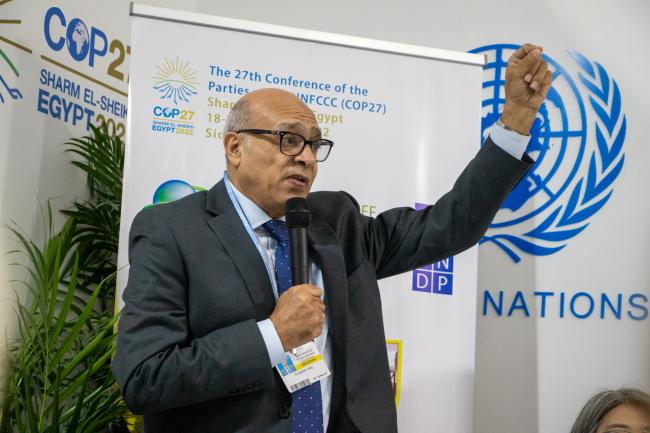
Civil society was present throughout these discussions, though its influence on negotiations remained limited. Dr. Imad Adly, President of the Arab Network for Environment and Development, summed up this sentiment: “What we fear is that the sea continues to be celebrated more than it is protected. We hear beautiful speeches, but along the shores we see the truth: plastic is spreading, species are disappearing, and human pressures are expanding without control. We need real commitments, not just words of solidarity.”
His statement captures the core of the gap between ambition and reality and reflects growing concern among non-governmental actors that decisions remain largely consensual rather than binding.
Dr. Adly added that current events represent “a true test of the ability of stakeholders to protect citizens’ right to a healthy environment.”
He emphasized that civil society, due to its closeness to the field and daily contact with affected communities, “has developed a clearer understanding of the scale of imbalances,” stressing that its voice is no longer secondary but an essential early-warning mechanism.
He added that tackling environmental challenges requires “courage in decision-making, expanding partnership spaces, and genuine appreciation of local knowledge,” noting that delays in action “transform environmental issues from simple symptoms into threats to social justice and human security.”
Civil Society and the Plastic Crisis
Scientific and environmental organizations, associations, and citizens addressed a joint open letter to Mediterranean environment ministers during the summit, calling for urgent, ambitious, and unified action to stop the plastic crisis choking the Mediterranean Sea.
The letter carried a strong warning tone, stressing that due to its semi-enclosed nature and dense coastal human activity, the Mediterranean has become one of the most plastic-polluted seas in the world. Every year, 230,000 tons of plastic are dumped into it, and more than 7 million tons have accumulated in its depths. Large portions of the sea have become sinks for plastic waste that enters but does not leave.
This severely restricts the natural renewal of water masses and increases the risks posed by persistent plastic pollution to biodiversity and coastal economies.
The letter notes that scientific evidence is unequivocal: the world has exceeded planetary boundaries related to chemical and industrial pollution, posing serious threats to ecosystems and human health. It criticizes the failure of global plastic treaty negotiations in Geneva and calls on Mediterranean countries to lead a regional alternative model instead of waiting for global consensus.
The letter presented several key demands: declaring plastic pollution a regional environmental emergency; strong support for the global plastics treaty with commitments to sign and ratify it; binding targets to reduce plastic use and leakage into the sea by 50% by 2030; establishing a transparent monitoring mechanism and shared regional database; creating a Mediterranean solidarity fund for vulnerable countries; and integrating plastic reduction into all sectoral policies (tourism, transport, industry, health, etc.).
In a tone of historical responsibility, the letter told ministers: “The decisions made in Cairo will be recorded in history.” It called for a binding, measurable agreement rather than non-actionable declarations, stressing that protecting the Mediterranean is a shared responsibility that cannot be delayed.
Dr. Imad Adly, President of the Moroccan Network for Environment and Development, commented: “This letter reflects a collective voice that cannot be ignored. It comes from the heart of the scientific and civil community that closely monitors how the Mediterranean is suffocating from plastic pollution. The figures are not just environmental indicators; they are real warnings threatening human health, marine stability, and the prosperity of coastal economies.”
He added: “The transition from diagnosis to action has been delayed for far too long. If Mediterranean countries do not assume their shared responsibility today, we will lose one of the world’s most critical and fragile seas. What is needed now is a courageous decision, binding agreements, strict monitoring, and fair financing that reflects solidarity between North and South.”
He concluded by emphasizing that: “The Mediterranean is not only a shared geography but also a human and cultural memory connecting millions of people. Protecting this heritage is a collective duty, and the letter reflects the pulse of the environmental public in the region. We must take it seriously.”
Side events revealed dynamic exchanges, especially on marine pollution, wetlands, and the MedProgramme. However, this momentum remained largely within the realm of dialogue rather than triggering new concrete actions, raising once again the question of whether such events can truly influence official decision-making.
The Mediterranean at a Crossroads
Overall, COP24 in Cairo was successful in terms of organization and exchanging visions, but it did not represent a turning point in political commitment, financing, or legal enforceability. Consensus-based language dominated, and decisions remained mostly advisory. Protecting the Mediterranean, amid growing climate and environmental threats, remains a battle requiring stronger political will and bolder choices.
As the region enters a new decade of challenges, one question looms: Will the Mediterranean remain a platform for environmental cooperation, or will it become an arena that exposes the limits of such cooperation?
Based on what transpired in Cairo, the Mediterranean now stands at a decisive crossroads: it will either become a global laboratory for environmental solutions, or a mirror reflecting the boundaries of regional cooperation. The future now lies in the hands of policymakers, either commit seriously and concretely to protecting the Mediterranean, or risk losing one of the world’s most fragile and vital seas.
To watch Dr. Imad Adly’s intervention during a side event at the summit, click here.