Tunis : Mohammed Tafraouti
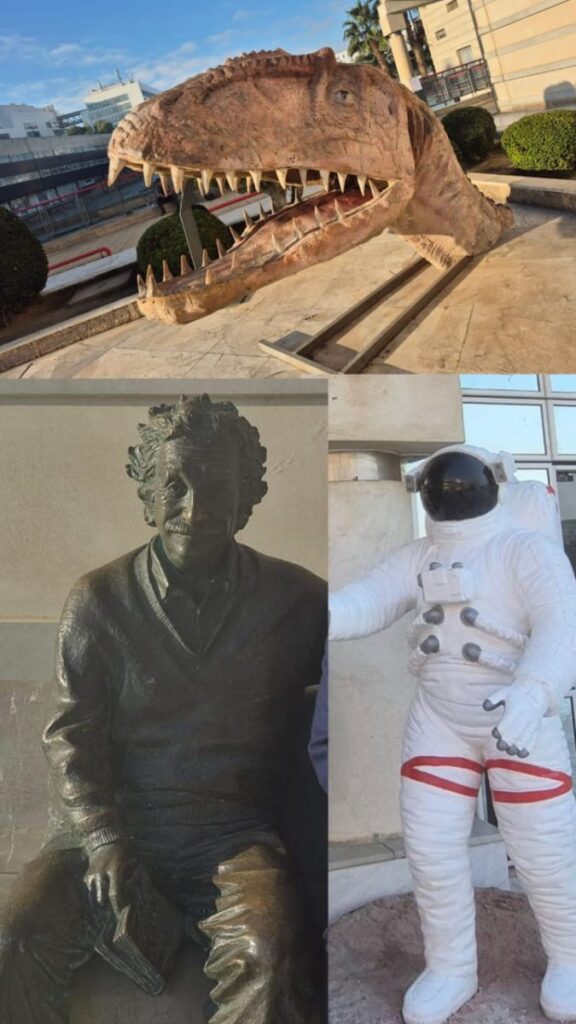
At the entrance of the City of Sciences in the Tunisian capital, a giant dinosaur head rises before visitors, jaws open, sharp teeth exposed, a silent witness to eras in which creatures dominated and then vanished, long before humanity turned toward science and the future.
In its stillness, it tells how species once prevailed and then disappeared, leaving behind the enduring question of survival and the limits of balance. This fossilized sentinel, standing like a guardian of natural memory, seems not merely an exhibit, but an early warning of destinies that lost harmony with their surroundings.
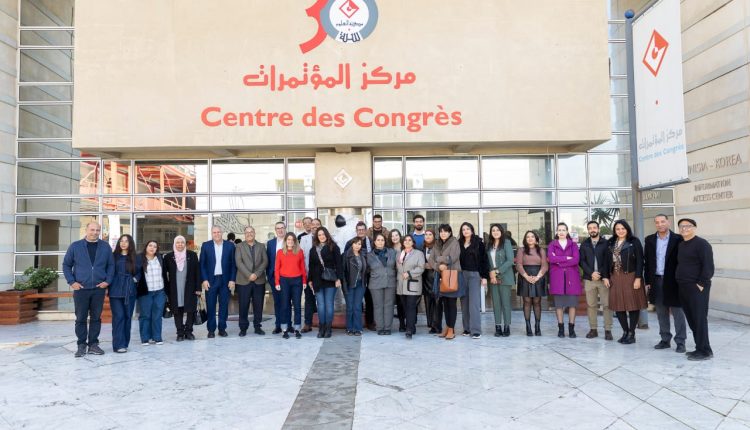
To the right of the hall hosting the Mediterranean protection workshop, in the courtyard of the scientific complex, a statue of Albert Einstein sits in his characteristic calm, a book resting in his hands, as if contemplating the trajectory of ideas and the evolution of knowledge. Nearby, a white-suited astronaut stands in perpetual readiness, arm extended toward the unknown.
Between an entrance that evokes the past of extinction and a square that anticipates the horizons of the future, the footsteps of scientists, researchers, and experts intersect. The presence of environmental journalists stands out as they embody the bridge between knowledge and society. They are not merely participants in the workshop, but active agents in conveying the image of the Mediterranean, its resources and its environmental challenges, to the outside world, complementing scientific efforts in fostering awareness and encouraging sustainable decision-making.
Thus, a cohesive Maghreb mosaic forms around a single question: How can the Mediterranean be saved before it, too, becomes merely a trace in geological memory?
Media and the Sea: From Coverage to Responsibility
In his opening remarks, Mr. Julien Chambolle, Secretary General of the association Africa21, emphasized that organizing the third meeting dedicated to Maghreb journalists on Mediterranean protection and the sound management of marine resources in 2025 was not a casual choice. Rather, it aligned with the major international shifts witnessed that year regarding oceanic and environmental issues. He stressed that the workshop aims to strengthen the media’s role in disseminating environmental knowledge, combating misinformation, and building bridges of trust and cooperation between experts and journalists in service of the public good.
He added that the workshop also marks the launch of a joint Maghreb media campaign to raise awareness about Mediterranean protection during December 2025 and January 2026, at a time when combating environmental misinformation has become an urgent necessity. This explains the association’s engagement in UNESCO-led initiatives aimed at reinforcing the integrity of environmental and scientific information.
From this media-oriented entry point, the discussion moved smoothly to the heart of the scientific issue, revealing that the Mediterranean is not merely a subject of coverage, but a complex environmental system that demands multidimensional understanding.
The Mediterranean: A Small Sea with Major Crises
The scientific presentations delivered throughout the workshop painted a precise picture of the environmental complexity of the Mediterranean basin. During the morning session of the first day, emphasis was placed on the sea’s uniqueness as one of the world’s foremost biodiversity “hotspots,” highlighting the role of marine protected areas and national parks in safeguarding fragile ecosystems. Yet this ecological importance is matched by growing vulnerability due to climate change, rising water temperatures, and disrupted marine currents.
In this context, Dr. Mounia Bour, Chair of the C4 Committee at the International Commission for the Scientific Exploration of the Mediterranean Sea (CIESM) in Tunisia, provided an in-depth scientific assessment, affirming that the Mediterranean is undergoing a critical and unprecedented phase. From the 1992 Rio Summit to the horizon of COP30, the gap has widened between global discourse on sustainable development and its actual integration into public policies. She explained that environmental governance in the region remains fragmented, complicating the management of inherently interconnected issues such as climate, water, biodiversity, and development.
She noted that more than half a billion people live in Mediterranean basin countries, with nearly one-third concentrated along the coasts, while the region also hosts approximately one-third of global tourism. These pressures manifest in water resource depletion, forest fires, pollution, urban sprawl, intensified agricultural activity, and climate change, leading to what she described as the “urbanization of climate” in the Mediterranean.
Science Confronting Structural Imbalances
Building on this diagnosis, Dr. Bour stressed that addressing the Mediterranean’s reality requires “thinking differently,” grounded in acknowledging the complexity of ecological and social systems and adopting interdisciplinary approaches. She highlighted the historic role of CIESM in defending scientific independence and the reliability of knowledge.
She explained that long-term scientific monitoring programs such as HYDROCHANGES and T-MedNET have revealed an accelerated rise in sea temperatures, both surface and deep waters, accompanied by marine heatwaves that have caused mass die-offs of marine organisms. Additionally, nearly 986 non-native species have been recorded, representing one of the highest biological invasion rates globally.
In response to these transformations, digital tools have emerged as new levers for understanding and adaptation through projects such as PRISM, which offers three-dimensional visualization of scientific data supported by artificial intelligence. She warned that the frequency of extreme phenomena could increase by 10 to 30 percent by mid-century, doubling adaptation costs and threatening coastal infrastructure.
A Scientific Mosaic of Intersecting Perspectives
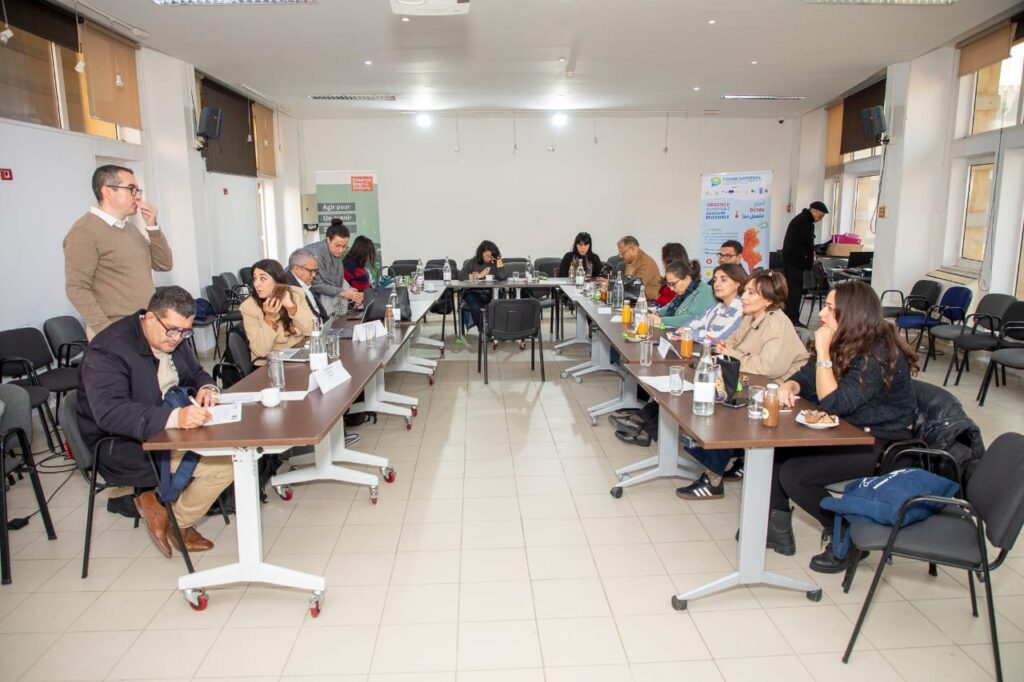
The workshop was animated by experts and researchers from diverse scientific, regional, and international institutions, giving the discussions a composite dimension. Within the strategic framework for Mediterranean protection, Antoine Lafitte, Acting Director of Plan Bleu, one of the Regional Activity Centres of the Mediterranean Action Plan under the United Nations Environment Programme, delivered an analytical reading of the structural challenges facing marine sustainability, emphasizing the need to shift from crisis management to proactive planning based on monitoring and scenario building.
Regarding biodiversity and marine protected areas, Yassine Ramzi Sghir from the SPA/RAC Regional Activity Centre and Amjad Khiar Eddine from the association Notre Grand Bleu stressed that protected areas are not zones of isolation but dynamic tools for restoring ecological balance, provided that local communities are involved and conservation is linked to development.
On plastic pollution, Sana Ben Ismail from the National Institute of Marine Sciences and Technologies (INSTM) explained that plastic is no longer merely visible waste but a micro-pollutant infiltrating the food chain. Noureddine Zaaboub, a member of the international GEOTRACES program, which aims to improve understanding of biogeochemical cycles and the distribution of trace elements and isotopes in marine environments, addressed chemical pollution as a silent threat with long-term cumulative effects.
This perspective was complemented by Samson Biller from Plan Bleu, who discussed seawater desalination as a strategic yet environmentally challenging option if not integrated into a comprehensive water resource management vision. Mr. Monji Bourguiba from the University of Tunis examined the impacts of unregulated urban expansion on coastlines, while Yassine Skandrani provided a technical assessment of overfishing and its repercussions on fish stocks and food security.
From History to Financing: The Mediterranean Between Will and Resources
The intervention of Zekra Gharbi, Director General at the Ministry of Environment and National Focal Point for the Mediterranean Action Plan, returned the discussion to its historical and institutional dimension. She affirmed that fifty years of joint efforts have achieved significant gains, yet they remain insufficient in the face of accelerating crises. Although the Mediterranean represents only 1 percent of the world’s ocean surface, it contains 7 percent of global microplastics and is warming 20 percent faster than the global average.
In the same vein, African Development Bank experts Diego Velasco and Javier Aust Fernández highlighted the financing gap in the blue economy in North Africa, noting that considerable economic potential collides with financial and structural deficits, thus requiring a stronger role for development banks and innovative financing instruments.
Media as a Bridge Between Science and Society
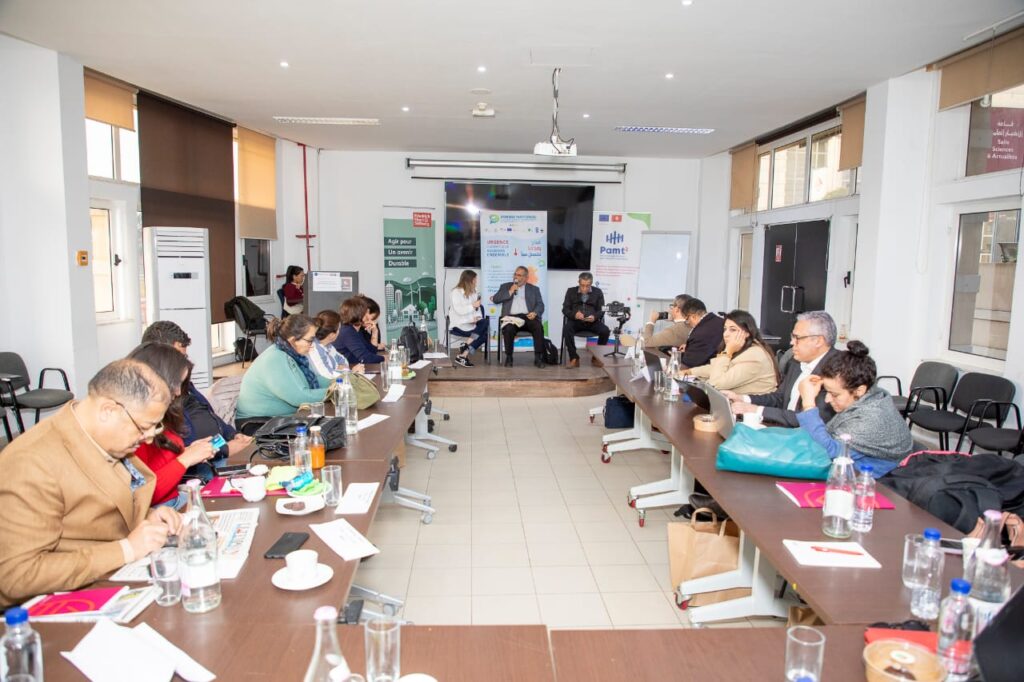
The workshop concluded with a specialized training session for journalists on the use of scientific sources in producing reliable media content, within the framework of the PAMT2/DWA program supporting media in Tunisia. Symbolically, it summarized a full day’s journey, confirming that protecting the Mediterranean cannot be achieved by science alone, nor by policies alone, but through responsible media capable of transforming knowledge into awareness, and awareness into action.
Field Day in Bizerte: Exploring the Sea and Its Actors
The third day of the workshop was dedicated to a field visit to the city of Bizerte, where participants observed manifestations of coastal erosion and their environmental impacts. The tour also included a visit to the Dar El Hout Museum in Sidi Heni to discover local maritime heritage, as well as the old traditional fishing port in the region, offering participants direct insight into coastal activities and the challenges facing Mediterranean marine environments.
Thus, between Einstein and the astronaut, the Mediterranean itself appeared suspended between deep reflection and necessary adventure. Either science becomes decision and media becomes a force for change, or this beautiful sea will remain trapped in crisis management rather than reclaiming its vitality.