By Mohammed Tafraouti
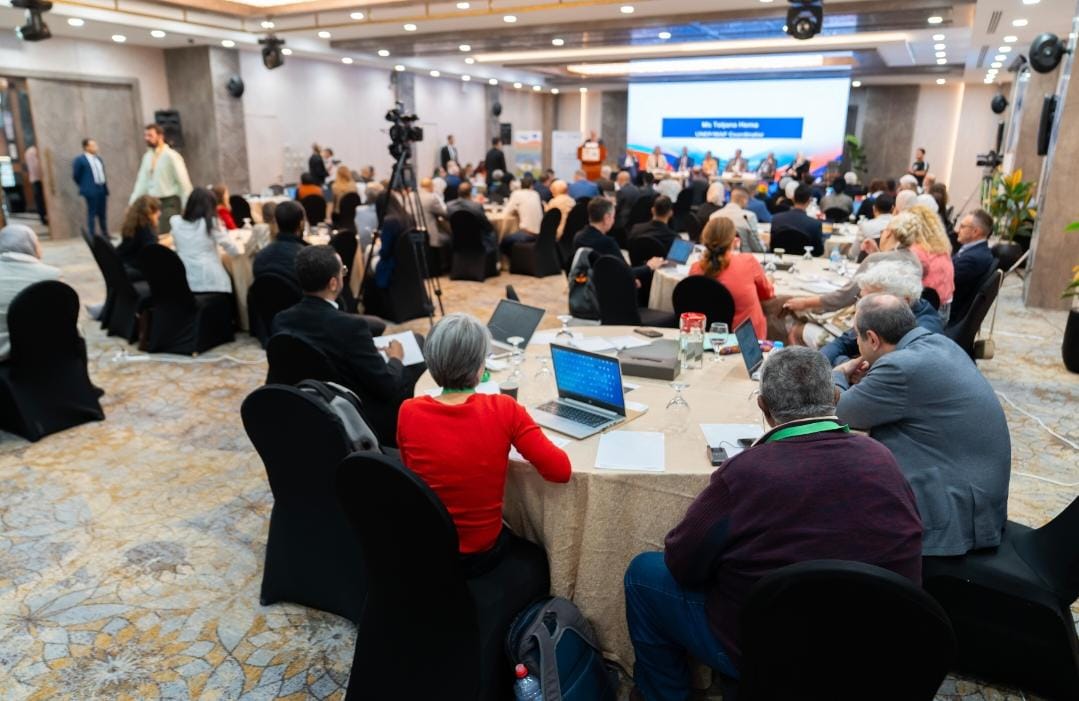
As part of the Regional Forum held in Cairo, Egypt, from October 21 to 23, 2025, the Mediterranean Information Office for Environment, Culture and Sustainable Development (MIO-ECSDE), in partnership with the Water and Environment Support Project in the Southern Mediterranean (WES-BCA) and the Global Environment Facility-funded Mediterranean Program (GEF), hosted a Mediterranean Stakeholders Forum under the theme, “Promoting Behavioral Change for a Sustainable Mediterranean Future.” The event was organized and coordinated by the Arab Network for Environment and Development (RAED), with the support of the European Union.
The forum brought together a wide range of participants, representatives of civil society organizations, the League of Arab States, parliamentarians, experts, journalists, as well as women’s and youth organizations from both shores of the Mediterranean. The discussions focused on strengthening climate action and integrating environmental and development efforts across the region.
In one of the key scientific sessions, Professor Joel Guiot, Co-Coordinator of the Mediterranean Experts on Climate and Environmental Change Network (MedECC), delivered a comprehensive online presentation titled, “Climatic and Environmental Drivers of Change in Coastal Areas.” He highlighted the major risks, challenges, and opportunities facing the Mediterranean Basin amid accelerating climate and environmental changes, emphasizing the urgent need for integrated and participatory policies to protect coastal zones and enhance their adaptive capacity.
The MedECC Network and Its Mission
Professor Guiot explained that the Mediterranean Experts on Climate and Environmental Change Network (MedECC) was established in 2015 as an independent scientific platform aiming to assess environmental and climate risks in the Mediterranean region.
He noted that the network serves as a scientific-policy interface linking research with decision-making, contributing to the improvement of public policies for the well-being of current and future generations. The network’s work, he said, is based on a rigorous scientific process that includes the selection of authors based on competence and geographical and gender balance, reliance on peer-reviewed studies, open review by the scientific community, and strict transparency in data sourcing.
MedECC reports, he stressed, are not merely descriptive but provide analytical insights that enable evidence-based policymaking, while remaining free from political orientation.
Coastal Risks
According to Guiot, Mediterranean coastal areas are increasingly exposed to risks such as flooding, coastal erosion, and rising sea levels. He noted that traditional engineering measures, such as barriers and dikes, are often ineffective in the long term, as they fail to account for future sea-level rise projections.
Conversely, he highlighted that Nature-Based Solutions (NBS) show promising potential, though they require trade-offs in land use and benefits. Relocating infrastructure or communities from highly sensitive areas, he added, could be a successful strategy if planned equitably and systematically.
Achieving a livable future, Guiot emphasized, requires a transformative shift across all sectors, systems, and governance levels, as current adaptation measures are insufficient to meet the Sustainable Development Goals (SDGs).
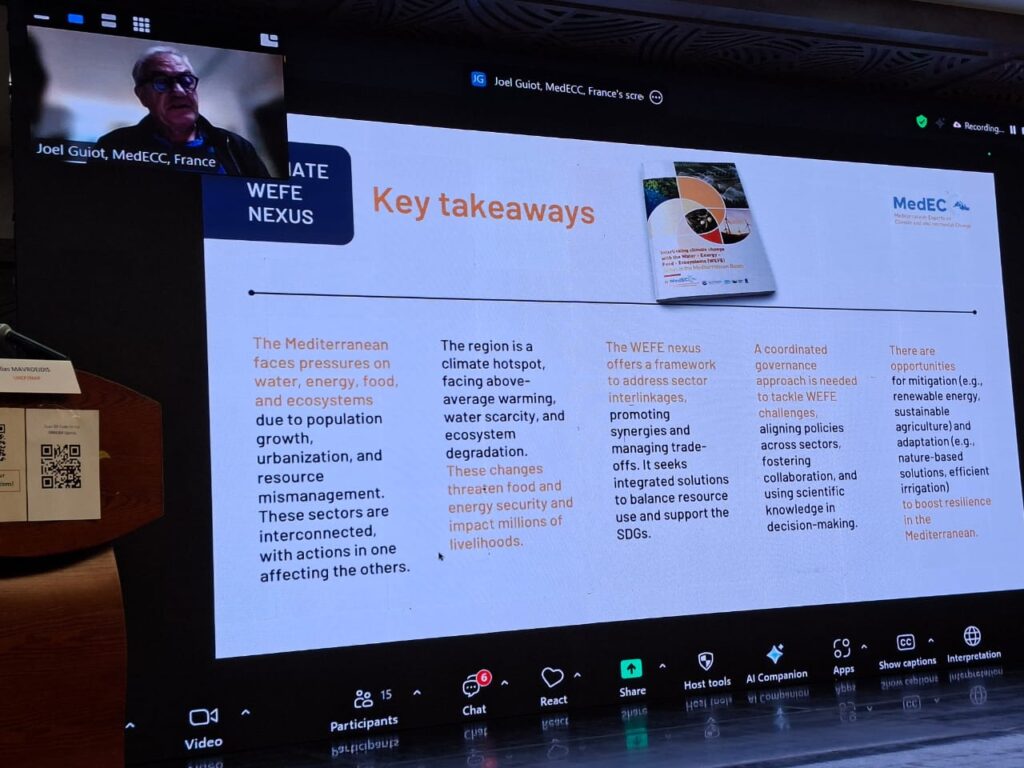
The WEFE Nexus, Water, Energy, Food, and Ecosystems
Guiot described the Mediterranean as a climate hotspot, facing above-average temperature increases, acute water scarcity, and ecosystem degradation. These changes, he warned, threaten water, food, and energy security and impact the livelihoods of millions of people.
He underlined that the Water-Energy-Food-Ecosystem (WEFE) Nexus provides an integrated framework to address these interconnections, by enhancing synergies among sectors, managing trade-offs, and adopting holistic and sustainable solutions that support SDG achievement.
He further stressed that coordinated cross-sectoral governance is crucial to overcome challenges, through policy harmonization, strengthened cooperation, and the use of scientific knowledge in decision-making. Promising opportunities, he noted, include renewable energy, sustainable agriculture, nature-based solutions, and improved irrigation efficiency.
Environmental Change, Migration, and Conflicts
Guiot explained that armed conflicts have severe indirect consequences on the environment and economy, including the destruction of infrastructure and industrial facilities. He stated that conflicts, persecution, famine, and natural disasters displaced more than 68 million people across the Mediterranean by the end of 2017.
The influx of migrants and refugees, he added, poses significant challenges for host communities, sometimes leading to local tensions and conflicts. The resilience and adaptive capacity of communities, both locally and regionally, play a crucial role in reducing overall risks.
He emphasized that governments in the Middle East and North Africa could greatly benefit from regional cooperation and breaking environmental-diplomatic barriers, to mitigate the human suffering caused by the interplay of environmental change, migration, and conflict.
A Decade of MedECC Reports (2015–2025)
Guiot traced the ten-year journey of the MedECC network since its creation in 2015. In 2020, the network published its first assessment report (MAR1), which received the North-South Prize from the Council of Europe. In 2021, its Summary for Policymakers (SPM) was endorsed during the COP22. In 2022, MedECC contributed to the Sixth Assessment Report of the Intergovernmental Panel on Climate Change (IPCC AR6).
This was followed by two special reports in 2024, on climate change, the WEFE Nexus, and coastal risks. The network is currently preparing a new report (MAR2), scheduled for 2025, focusing on environmental change, conflicts, and human migration.
Joel Guiot concluded by affirming that sustainable development in the Mediterranean will not be possible without joint efforts among scientists, policymakers, and local communities. Collaboration, integration of science and policy, and behavioral change, both individual and collective, are, he said, the keys to achieving an environmentally, socially, and economically balanced future.