Cairo – Mohammed Tafraouti
On the sidelines of the Mediterranean Forum on Environment and Climate Action in Cairo, themed “From Awareness to Action” , I met with Dr. Imad Adly, President of the Arab Network for Environment and Development (RAED), and one of the most prominent figures who have solidified the presence of civil society organizations across the Arab and Mediterranean spheres.
A physician by training, Dr. Adly chose to extend his diagnosis from the human body to the body of society, from the clinic to the world , carrying with him a deep sense of reform and the responsibility of building. Often described as an icon of Arab civil society, he possesses a rare ability to bridge thought and fieldwork, science and belief in action, humanity and the environment, all within one equation whose title could be “A Dignified Life on a Balanced Planet.”
In his discourse, he does not speak of the environment as a technical dossier, but as a system of values and a civilizational behavior; nor does he view civil society as a “third sector,” but rather as the beating heart of human relations and collective awareness.
Our conversation was an intellectual journey tracing the path from awareness to action, from action to vision, and from vision to a Mediterranean roadmap rooted in the belief that real change becomes possible when genuine wills converge.
By the end of our dialogue, Dr. Adly appeared as someone drawing a map of hope amid the storms, convinced that environmental transformation is not born of declarations but of determination , and that building bridges between the two shores of the Mediterranean is not a diplomatic dream, but a human and strategic duty.
He spoke with the insight of a physician who seeks the root causes of disease rather than merely easing symptoms, and with the mind of a leader who sees civil society as a laboratory for ideas and a cradle of transformation, not as a substitute for the state, but as a partner in shaping the future.
In his vision, there is no “advanced North” or “dependent South”, but a single Mediterranean family sharing air, water, and destiny. In his words, environmental diplomacy emerges not as a language of negotiation, but as a language of life, one that reorders priorities and places humanity once again at the center of the equation.
From Cairo, and from the heart of the Mediterranean Forum, his voice rang clear:
“It’s not enough to know the danger; we must change the course… Action is the most profound form of awareness.”
Through this encounter, Dr. Imad Adly left yet another mark, reaffirming that the environment is not a sectoral issue, but a civilizational project, and that building a conscious Mediterranean civil front is the first step toward a fairer and more sustainable future for generations to come.
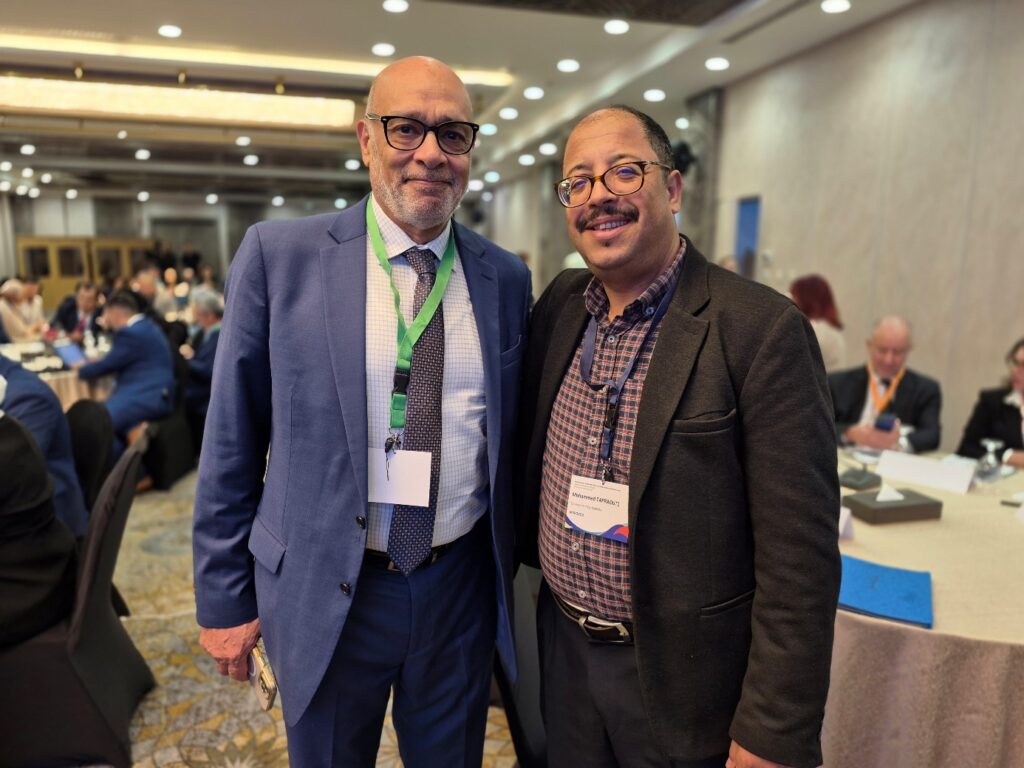
The Doctor Who Healed the Mediterranean: A Conversation with the Architect of the Environmental Civil Front
From this intellectual starting point, we dive into the depths of a dialogue that illuminates the path ahead:
Q: As a physician skilled in reading symptoms before diagnosing the illness, how do you read the “symptoms” of the Mediterranean region today, environmentally speaking?
A: The region suffers from chronic symptoms: drought of resources, stagnation of policies, and a lack of participatory oxygen among actors. My diagnosis is that the solution lies not in quick prescriptions, but in comprehensive therapy, one that begins by reshaping collective behavior and activating the collective intelligence of organizations. The environmental challenge is not a biological disease but a dysfunction in our relationship with life itself.
Q: You combine the precision of a doctor with the flexibility of a community leader. What is the secret of your success in building a civil front that bridges both shores?
A: The secret is listening. You cannot build a front without hearing the other’s pulse. We’ve tried to turn disagreement into difference, and difference into a force for creativity. Each organization in our network is not a number, but a living cell within one Mediterranean body, diverse in its languages, united in its human heartbeat.
Q: In an era of accelerating climate transformations, is awareness enough, or do we need a “shock therapy” to change behaviors?
A: Awareness is diagnosis, but it doesn’t heal by itself. We need a societal behavioral therapy that integrates education, media, and public policy into one protocol. The shock therapy I believe in is citizen participation, not as beneficiaries, but as agents of change. True transformation begins when environmental action becomes a habit, not a slogan.
Q: Many initiatives collapse under bureaucracy or conflicting interests. How did you turn a dream into an effective network?
A: We faced this by adopting a principle of “field before platform.” We didn’t build the network from offices, but from shared workshops and grassroots dialogues. When people witness impact, they believe in the project. That’s why we focused on tangible initiatives, local water management, environmental education, and the green economy. Success starts from small details, not grand slogans.
Q: The Mediterranean Forum in Cairo carried the theme “From Awareness to Action.” How do you interpret this motto after living the experience?
A: It’s not a slogan, it’s a formula for life. Awareness without action is diagnosis without cure; action without awareness is adventure without compass. What happened in Cairo was the fusion of both: scientific awareness, collective action, and faith that the sea dividing us can also unite us.
Q: Leadership in the environmental field is not just project management; it’s guiding a collective conscience. How do you shape transformative leadership within your network?
A: We’re not seeking a “leader,” but a shared echo. Leadership, to me, is distributive, not hierarchical. Every member of the network is a leader in their domain. When we liberate leadership from centralization, we create true empowerment and a network that thinks and acts as one living organism.
Q: Young people today represent the rising force in climate action. How can their enthusiasm be transformed into a lasting institutional energy?
A: By listening before training. Youth don’t want to be lectured , they want to be empowered. We integrate them into decision-making, not just volunteering. We equip them with critical thinking tools and environmental analysis skills, and give them space to experiment. The future is not inherited , it is built with them.
Regarding youth, I’d like to highlight that within RAED, we launched in 2022 the RAED Youth Network , a platform that brings together young representatives of member organizations under the umbrella of the mother network. This initiative stems from a firm belief in empowering youth and ensuring their active involvement in Arab joint action and in the environmental and developmental causes championed by RAED. It also continues the legacy of the Arab Office for Youth and Environment, the very institution that initiated the idea of creating RAED over thirty years ago , and to which I still proudly belong. That office remains the foundation and source of my professional journey since the late 1980s.
Q: In a landscape filled with initiatives and competing organizations, how can we protect environmental action from fragmentation?
A: Through engineering, not enthusiasm alone. Fragmentation stems from a lack of shared vision. We work on developing a “Mediterranean compass”, one that ensures every initiative contributes to a broader ecosystem. We don’t want scattered projects, but an interwoven fabric of cooperation. Smart networking turns local efforts into regional impact.
Q: Climate justice is a widely used slogan, yet you treat it as a working methodology. How do you translate it into reality?
A: Climate justice is not just a moral demand, it’s a condition for shared survival. We work on building solidarity bridges between the northern and southern Mediterranean, based on knowledge exchange rather than instruction, and technology transfer rather than conditionality. Justice is achieved when development becomes an environmental right for all, not a privilege for a few.
Q: Environmental diplomacy has emerged as a new language among nations. How do you perceive it as a tool for peace and convergence?
A: Environmental diplomacy redefines soft power. When we sit together to discuss water and air, geopolitical conflicts fade. The environment offers a universal language that needs no translation. I believe that green diplomacy will be the key to the future, because it unites rather than divides, it builds trust where traditional politics have failed.
When we first launched the Nile Basin Initiative within RAED back in 2001, nearly twenty-four years ago, I made it a point to emphasize the concept of people’s diplomacy at every opportunity.
I firmly believe that people’s diplomacy is not merely a channel of dialogue between nations, but also a genuine opportunity to prevent conflicts and crises that might arise between states. Dialogue among peoples, civil society organizations, and local communities, when carried out through direct, reciprocal communication, becomes a positive force that creates real change.
From this standpoint, we practice people’s diplomacy across the Arab region, particularly within the Mediterranean space, which today , more than ever , needs an active people’s diplomacy to reinforce peace, enhance cooperation between both shores, bridge North and South, and strengthen South-South collaboration.
That is why we need a strong, steady people’s diplomacy, capable of building bridges and providing realistic solutions that support peace and cooperation throughout our region.
Q: Climate change puts pressure on resources but also reveals human creativity. How do you turn this challenge into an opportunity for a new economy?
A: Climate change is not the end, it’s the beginning of rebuilding a fairer economy. We believe every crisis carries the seed of opportunity. We foster green entrepreneurship, train youth in eco-innovation, and encourage sustainable livelihoods. The environment is not an economic burden , it is a source of innovation and economic dignity.
Q: From your experience in Cairo, what message should remain as a strategic legacy for future generations?
A: That awareness alone is not enough, and that individual action can generate collective impact. The Mediterranean is not merely a geographical line, but a shared memory and responsibility.
My message is simple: We will not save the environment through intentions, but through partnership, by redefining our relationship with the planet as conscious, proactive global citizens.