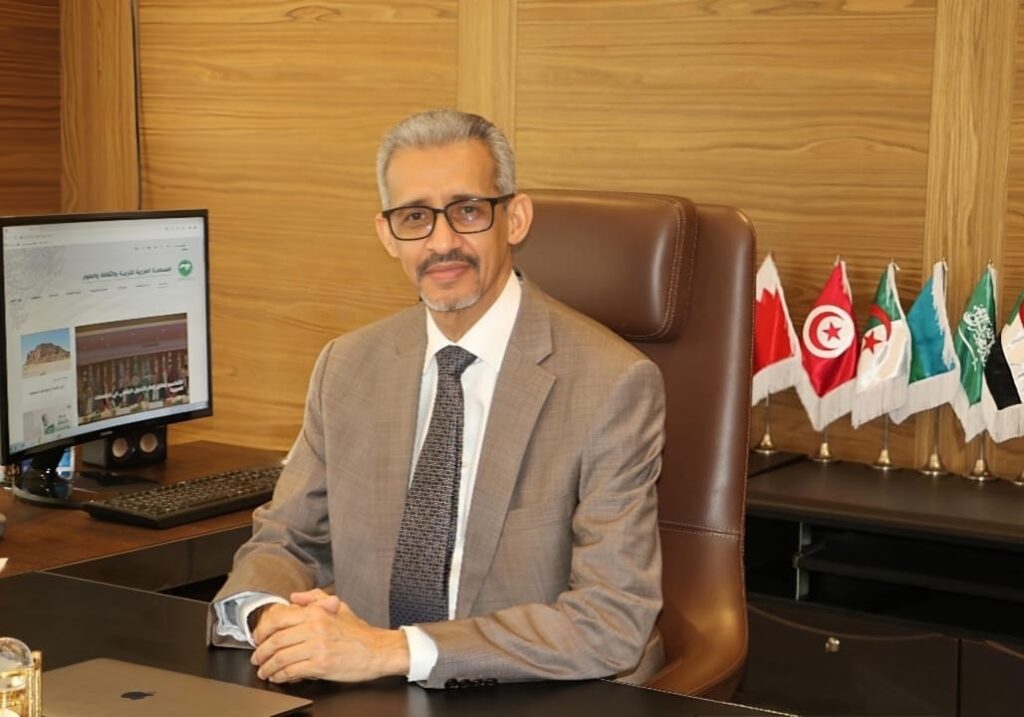
An Interview with His Excellency Professor Dr. Mohamed Ould Amar, Director-General of the Arab League Educational, Cultural and Scientific Organization (ALECSO)
By Mohammed Tafraouti
Amidst the world’s rapid transformations, where power dynamics are being reshaped on cognitive and technological foundations, it is no longer acceptable for Arab societies to remain sidelined in the grand battle unfolding across artificial intelligence, scientific innovation, and knowledge-based decision-making. Hence, the urgent need arises for an Arab consortium that transcends ceremonial or rhetorical functions, embodying a strategic project to integrate scientific research and media within an institutional, synergistic framework serving development and renaissance goals.
In this context, scientific media is neither a luxury nor a tool for superficial knowledge promotion; it is a civilizational and strategic imperative. It is the interface through which laboratory achievements translate into public policies, scientific discoveries transform into societal awareness, and the nation’s cognitive capital strengthens in the battle for destiny.
Thus, the philosophy of building scientific media capacities in the Arab world stems from a core conviction: cognitive sovereignty can only be achieved when scientists, journalists, educators, and policymakers converge within an institutional space that views scientific research not as a luxury, but as a prerequisite for survival and civilizational independence.
What do we seek from this program?
We aim to bridge the gap between journalists and researchers, replacing mistrust or disconnect with trust and collaboration. We aspire to train a new generation of science journalists capable of simplifying concepts without trivialization and culturally translating scientific knowledge within the Arab context. We strive to disseminate truthful information in an era of fabricated narratives and bolster public immunity against scientific and technical disinformation. We seek to entrench scientific sovereignty as a strategic concept—not merely localizing technology, but also critical thinking and the scientific method. Finally, we endeavor to build an Arab science communication ecosystem addressing people in their language and aspirations, free from alienation or regurgitation of non-transferable foreign models.
In this vein, Mohamed Tafraouti conducted an analytical dialogue with His Excellency Professor Dr. Mohamed Ould Amar to delve into this philosophy and explore initiatives and stakes in establishing this envisioned consortium.
Interview with H.E. Prof. Dr. Mohamed Ould Amar, Director-General of ALECSO
Question 1: Given the accelerating pace of science and technology, what justifies establishing an entity integrating media and science in the Arab context?
Answer: The rationale lies in structural challenges, most notably widespread scientific illiteracy and the disconnect between research knowledge and the public sphere. This gap between scientific output and societal recipients creates a vacuum often filled by misinformation or narratives lacking scientific basis. Thus, an institutional body is essential to restructure the relationship between scientific knowledge and media dissemination, achieving cognitive sovereignty and activating science’s role in shaping collective consciousness. This also reflects ALECSO’s pivotal role in implementing the Arab Strategy for Scientific Research and Innovation, where promoting scientific culture in Arab states is a top priority.
Question 2: What is the core philosophy behind the “Enhancing and Building Scientific Media Capacities” project in the Arab world?
Answer: This philosophy rests on three integrated pillars:
1. Liberating media from superficial treatment of science by equipping it with analytical and interpretive tools.
2. Bringing society closer to scientific research through specialized media that “humanizes” scientific concepts, not just deconstructing them.
3. Fortifying the public sphere against disinformation by producing credible, mass-circulated scientific content that respects scientific standards without compromising accessibility.
Question 3: How can scientific media help overcome scientific illiteracy and build a knowledge society?
Answer: When practiced professionally and purposefully, scientific media becomes a central tool to liberate Arab consciousness from passive knowledge consumption. It enhances individuals’ ability to distinguish opinion from knowledge, truth from claims. It does not merely simplify; it deepens understanding, restores trust in the scientific method, and serves as a key pillar of non-formal education in our societies.
Question 4: What is the researcher’s role in this vision? Must they be involved?
Answer: The researcher is not merely an information source but an essential partner in crafting scientific narratives. Engaging them in media spaces breaks the elitism of knowledge and fosters research-society interaction. Scientists’ openness to media relocates science to the cultural core of Arab societies, granting research a social and human dimension previously absent.
Question 5: Can scientific media be a strategic tool for development?
Answer: Undoubtedly. Scientific media is not a neutral intermediary but a developmental actor reshaping societal priorities by disseminating scientific knowledge and promoting evidence-based practices in health, environment, energy, and technology. Integrating it into public policies is fundamental to creating a knowledge-production culture underpinning sustainable development.
Question 6: How do initiatives like ALECSO’s program contribute here?
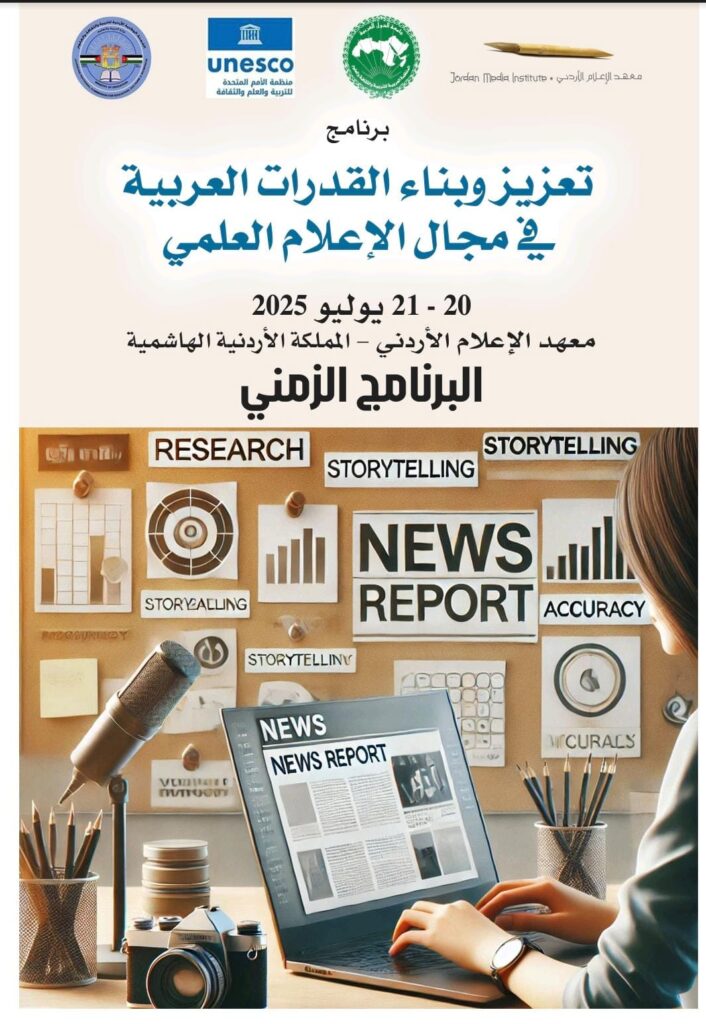
Answer: ALECSO’s initiative with UNESCO and the Jordan Media Institute represents a structural step toward establishing an Arab scientific media community. It is not merely a training course but a strategic paradigm shift integrating science into Arab media agendas. It consciously builds a critical mass of journalists capable of engaging major cognitive issues with language prioritizing accuracy, professionalism, and human dimension.
Question 7: Amidst information overload and widespread disinformation, what role does scientific media play in the battle for truth?
Answer: Scientific media is the last bastion against cognitive triviality and informational falsehoods, the objective counterweight to rationality in an age of confusion. Qualifying Arab science journalists to critically engage scientific phenomena and digital data lays the foundation for a society combating ignorance through partnership, not guardianship.