A Step Proving That Local Solutions Based on Scientific Knowledge Can Drive Sustainable Development
By Mohammed TAFRAOUTI
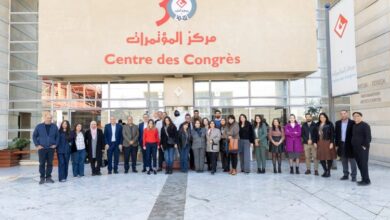
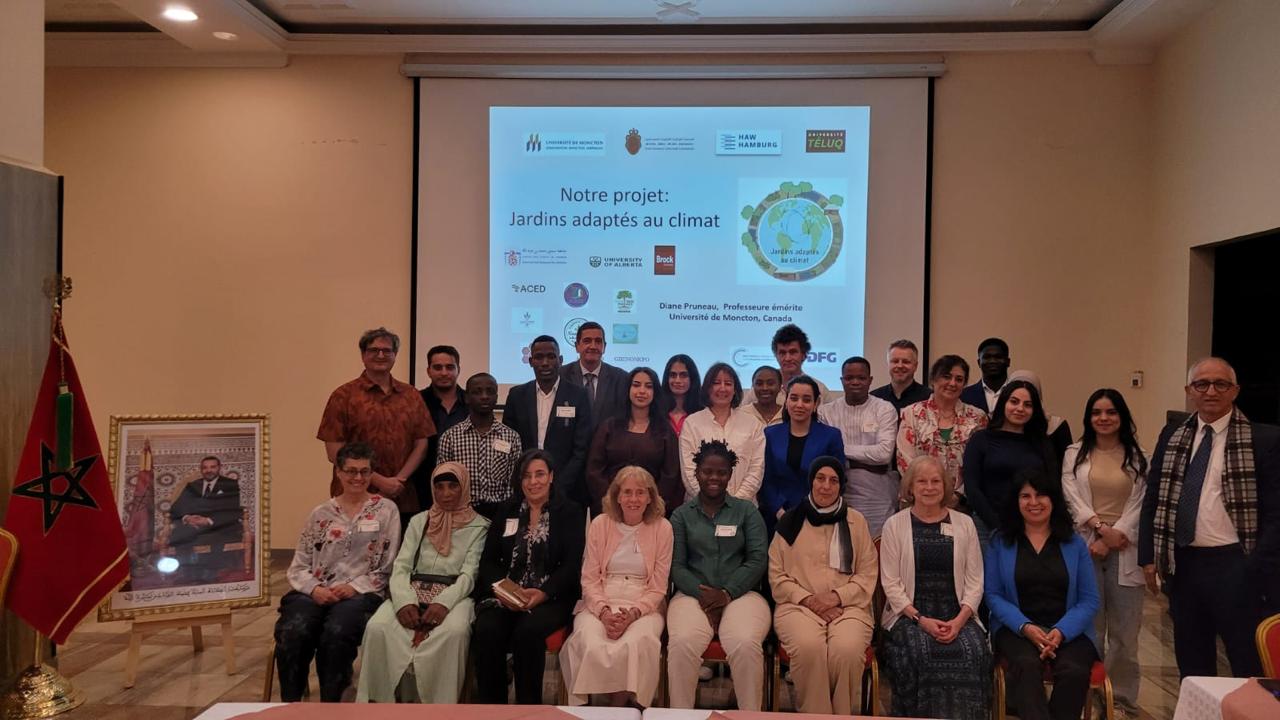
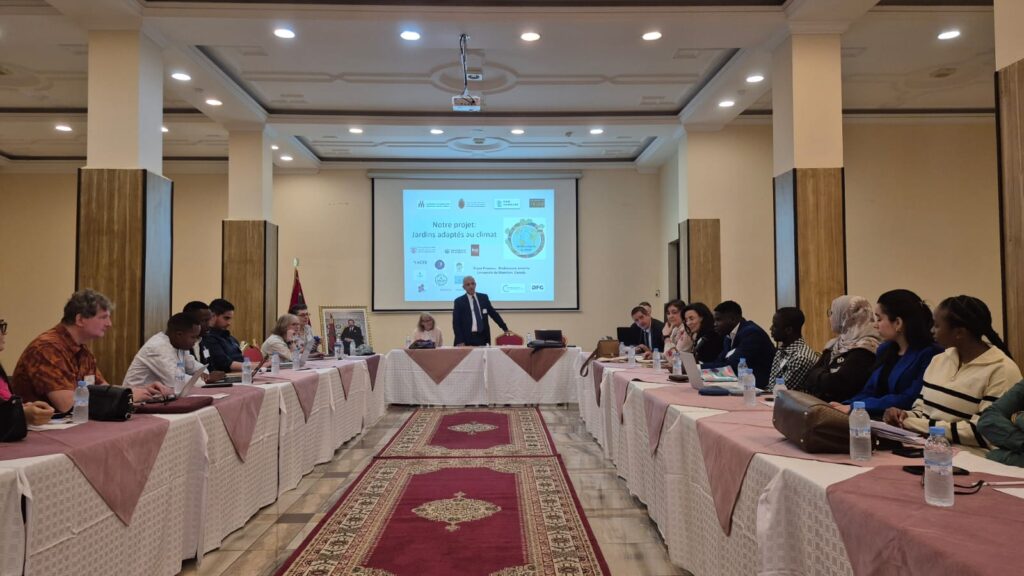
The second meeting of the Climate-Adaptive Gardens project was held in Marrakech from April 22 to 25, 2025, under the theme: “Towards Agriculture Capable of Adapting to Climate Change.” Researchers and experts from Morocco, Canada, and Benin participated in the event, where they discussed agricultural adaptation to climate change with a focus on the role of cooperatives in addressing climate crises and promoting local products.
The meeting featured rigorous scientific presentations and field visits, during which researchers shared successful case studies from the three countries, emphasizing the importance of local knowledge and participatory approaches in enhancing the resilience of agriculture and ecosystems.
In Morocco, an applied study was presented on the Azilal forest and climate modeling aimed at achieving carbon neutrality by 2050, alongside field data on non-wood forest resources, especially medicinal and aromatic plants, and the role of local cooperatives in their valorization. Two key cooperative initiatives were highlighted: the Aska Women’s Cooperative for Essential Oils and Saffron in Ait Ahmed, Azilal, and the Tamdahin Cooperative in Ait Bougmez – Azilal. Participants also examined the integration of women and vulnerable groups into sustainable agricultural value chains in Benin, while Canadian representatives discussed organic farming techniques and sustainable fertilization strategies in the context of accelerating climate change.
Researchers emphasized the need to adopt integrated strategies for agricultural and environmental development, involving local communities and promoting a solidarity-based green economy. They also called for strengthening South-South and North-South research cooperation through knowledge exchange and scaling successful models, along with expanding field training and incorporating scientific research outcomes into public policy-making.
Experts and researchers from Morocco, Canada, Germany and Benin examined the climate challenges faced by agricultural and forestry cooperatives and adaptation strategies through agroecology and nature-based solutions. Participants conducted field visits and presented scientific contributions to develop realistic solutions.
Field Experiences from Morocco, Benin, Germany and Canada
Participants presented three field experiences from Morocco, Benin, and Canada, each showcasing successful models of climate-resilient agriculture and enhanced local cooperative resilience. Benin’s experience focused on integrating women and vulnerable groups into the agricultural value chain, Canada’s experience highlighted the transition to organic farming and sustainable fertilization techniques, while Morocco’s case addressed forest restoration and local ecosystem management to support carbon neutrality by 2050.
The researchers stressed that climate-adaptive agriculture is key to ensuring food security and protecting natural resources, especially in environmentally and socially vulnerable areas. Field experiences in both Morocco and Benin demonstrated the effectiveness of participatory approaches that rely on local knowledge and nature-based solutions, while underscoring the need to build the capacities of cooperatives and support public policies aimed at fair and sustainable agroecology.
They further emphasized the importance of North-South and South-South knowledge exchange to develop innovative models that reflect the specific environmental and social characteristics of each region, advocating for investment in scientific research and fieldwork to build the resilience of local communities to climate change.
Forest Ecosystems in the Beni Mellal-Khenifra Region: A Rich Yet Threatened Resource
Researchers highlighted that the Beni Mellal-Khenifra region is one of the richest forested areas in Morocco—not only in terms of size but also in biodiversity and socio-economic value. The region includes about 830,000 hectares of forests, representing nearly 8% of Morocco’s national forest cover and covering 28% of the region’s total area. These forests are a primary livelihood source for mountain communities, offering firewood, livestock fodder, and medicinal plants, especially in areas with limited access to modern healthcare.
However, this vital natural resource faces growing threats due to human pressures such as overexploitation, unregulated agricultural expansion, overgrazing, and climate-related impacts like drought and cold waves.
A New Participatory Approach
A new approach has been adopted based on partnerships between forest authorities and local cooperatives, involving 20 contracts currently in implementation. These agreements focus on the valorization of wood and non-wood forest products, particularly medicinal and aromatic plants. This strategy has strengthened the role of local communities in forest conservation and value creation.
Scientific Study on Azilal Forest: Toward Carbon Neutrality by 2050
Participants presented an applied study on the Azilal forest, characterized by a semi-arid Mediterranean climate, facing increasing climate and human pressures. Using ecological and climate models (3-PG), the study simulated the forest’s evolution under various climate scenarios. It concluded that systematic silvicultural interventions could improve the forest’s carbon absorption capacity and achieve carbon neutrality by 2050.
Non-Wood Forest Products: Underutilized Potential
Researchers also examined the importance of non-wood forest products such as medicinal and aromatic plants in supporting local economies and achieving food security. They noted the lack of comprehensive data on their diversity, distribution, and productivity. A detailed field methodology was used to inventory these resources and assess their potential biomass, aiming to create accurate scientific maps and updated botanical lists to inform sustainable spatial planning.
These products play a crucial role in enhancing food security and nutritional quality for local populations, providing essential nutrients and health supplements. In a study aimed at promoting the sustainability and valorization of these resources, researchers conducted a field assessment and mapping of non-wood forest products in three key forest areas in the Beni Mellal-Khenifra region: Azilal, Ait Bougmez, and Ait Mohammed.
Despite their environmental and economic value, these products remain underrepresented in applied research, especially in the mentioned areas. The main challenge is the lack of precise data on plant species diversity, spatial distribution, and biomass productivity, hindering their effective integration into regional development and forest management plans.
Using a rigorous field-based methodology, researchers conducted a comprehensive inventory of non-wood plant species across the forest area, with 400 ecological sampling operations to gather data on vegetation cover, species density, and distribution. Plant units were classified according to distinctive biological characteristics.
To map the distribution of medicinal and aromatic plants, plant families were identified based on ecological standardization criteria, providing a clear visual representation of resource distribution. Additionally, biomass production potential was assessed by measuring, drying, and weighing samples, with results extrapolated to the full study area.
Initial findings included a comprehensive inventory of local non-wood forest products (particularly medicinal and aromatic plants), accurate distribution maps, and biomass production estimates. The study recommended integrating these natural resources into local sustainable management policies and enhancing research focused on their environmental and economic valorization.
Cooperatives of Aromatic and Medicinal Plants in Azilal: A Participatory and Innovative Approach
The cooperatives of aromatic and medicinal plants (AMPs) in Azilal represent a potential driver of sustainable development. However, their success depends on strengthening their organizational and technical capacities and enhancing their access to markets. Researchers, adopting a participatory and innovative approach, have addressed these cooperatives as a model to be followed for developing local stakeholders within the framework of the solidarity economy.
AMPs constitute a key element in the local economy and in environmental development strategies, especially in rural areas like Azilal Province, where these natural resources are integrated with traditional livelihoods. In the face of the gradual degradation of vegetation cover due to human and climatic pressures, the domestication of these plants—also known as “agricultural control”—emerges as a sustainable option that reduces pressure on natural resources and ensures species continuity.
However, many questions remain regarding the impact of this practice on soil quality and the extent to which plant productivity is linked to factors such as irrigation and solar exposure, particularly when comparing domesticated plants with their wild counterparts. Accordingly, the study aimed to understand the complex relationship between soil quality and yield—both above-ground and root biomass—of the aromatic and medicinal plants prevalent in the area, such as thyme.
The research methodology was based on detailed field experiments that included soil and plant sampling from different sites—some containing domesticated plants, others wild species, in addition to control soil samples. Measurements were carried out at multiple levels, including physical and chemical properties of the soil (such as bulk density, structural stability, and organic accumulation), along with morphological dimensions of the plants (such as height, diameter, and dry weight).
For domesticated plants, the study tracked the effect of annual irrigation volumes on thyme growth, while in natural environments, the impact of sun exposure on growth and productivity was analyzed. Measurements followed rigorous scientific techniques using representative samples and specialized measurement tools, enabling the collection of comparative quantitative data between both situations.
This study is expected to yield several results, most notably identifying the essential nutrients needed by domesticated plants, understanding the impact of domestication on the physical and chemical properties of the soil, and highlighting the effect of regular irrigation on improving productivity. It will also determine the optimal exposure conditions that enhance the biological productivity of wild plants, and analyze the most indicative markers of soil quality in relation to plant productivity.
These results will represent a significant scientific contribution to the rational exploitation of AMPs in Azilal and provide practical tools for developing sustainable development models that balance economic use and environmental preservation—especially in light of escalating climatic and agricultural challenges.
Towards an Integrated Strategy for Ecosystem Resilience
There is an urgent need for an integrated strategy that combines environmental and developmental dimensions, placing local communities at the heart of solutions by supporting the green solidarity economy, valuing value chains, and strengthening legal protection mechanisms linked to national programs with clear strategic horizons.
Forest ecosystems in the Beni Mellal-Khenifra region form a fundamental pillar for achieving sustainable development. However, they remain threatened unless efforts are intensified to manage them in a participatory way that ensures equitable benefits and maintains their environmental and functional balance for future generations.
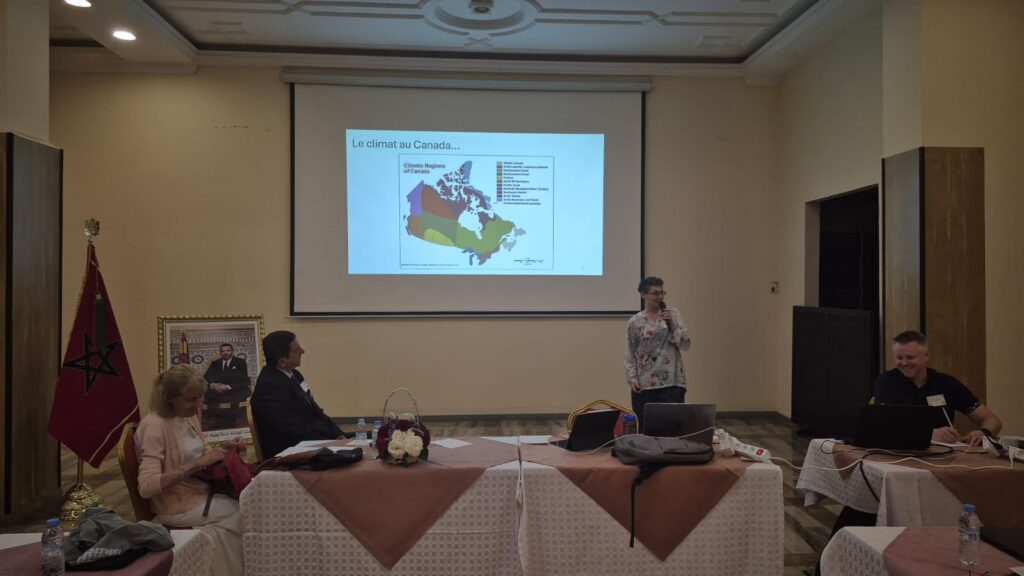
The Canadian Experience
As part of the Climate-Adaptive Gardens project, the Canadian team presented the activities carried out in collaboration with two vegetable farming cooperatives in Eastern Canada. Dr. Anne-Marie Laroche, professor at the Université de Moncton, Department of Civil Engineering, identified the main climate types in Canada, with a focus on the climatic characteristics of Eastern Canada, where market gardening is well developed.
She discussed the work conducted during the project’s first year. The field campaign allowed for soil analyses in addition to an inventory of plants and insects present on the two partner farms. These data were complemented by semi-structured interviews conducted with farmers and their clients to better understand their agricultural practices, needs, and perceptions regarding climate issues.
She also presented the planned activities for the second year. Two experimental protocols are currently being implemented. The first aims to measure soil temperature under different types of plastic covers. The second focuses on evaluating cover crops as a method of weed control, replacing herbicides.
This project follows a participatory and multidisciplinary approach based on the local context. It aims to identify agricultural practices adapted to the climatic context and the needs of producers and communities.
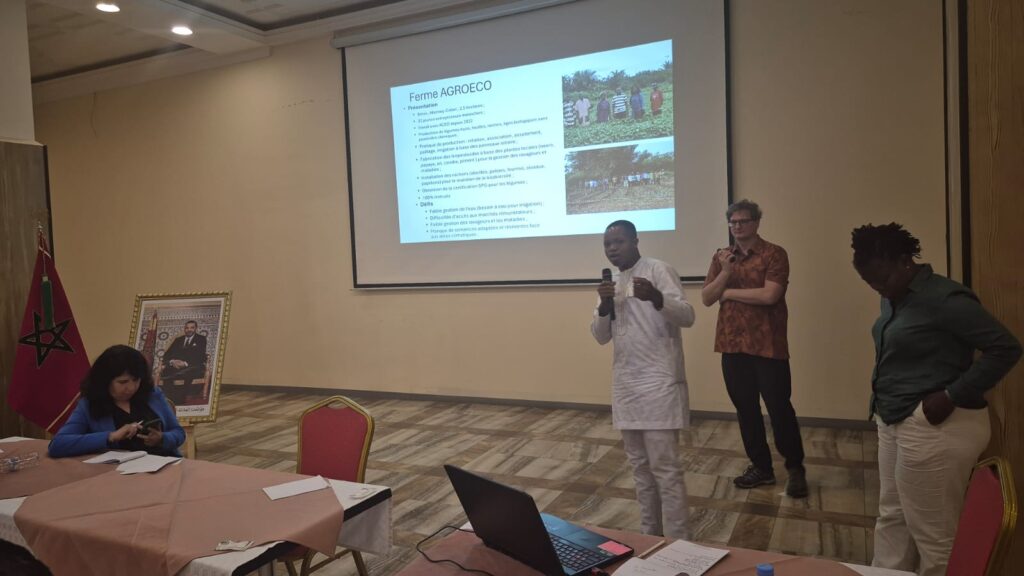
The Benin Experience
The Beninese research team presented the experience of farms hosting the “Climate-Adaptive Gardens through Resilient Farming in the Face of Climate Change in the So-Ava / Abomey-Calavi Areas – Benin” project.
The researchers emphasized that, as a promising step toward promoting sustainable agriculture in Africa, the AGROECO and GBENONKPO farms in Benin are hosting an innovative project that combines local innovation with international scientific cooperation to address climate change challenges threatening agricultural production and food security.
Implemented by the ACED organization with support from experts from Canada and Morocco, the project aims to strengthen agricultural cooperatives’ capacity to adapt to fluctuating climatic conditions through nature-based solutions and environmentally friendly farming practices such as crop rotation, solar-powered irrigation, and the development of biopesticides from local plants such as neem, papaya, garlic, and chili.
The AGROECO farm, located in Abomey-Calavi, includes 32 young pioneers of organic farming. It specializes in the production of natural vegetables free from chemical pesticides and has received the SPG agricultural quality certification. The GBENONKPO farm in the So-Ava area includes 11 farmers and is among the first initiatives to convert the aquatic “nymphaea” plant into organic fertilizer—an innovative environmental experiment.
Farmers face ongoing challenges such as poor water resource management, limited market access, and insufficient availability of climate-resilient seeds.
The project involved field visits, individual and group interviews with farmers, participatory workshops for resource assessment and soil and water analysis, as well as land-use mapping. The scientific team is working to develop local solutions that enhance these farming communities’ resilience to climate variability through knowledge exchange, conceptual modeling, and evaluation of material and financial farm flows.
Project leaders hope these experiences will create a shared platform for exchanging expertise between Africa and Europe, especially with Germany and Canada engaged in supporting environmental transformation and enhancing North-South scientific cooperation.
The forum served as an important opportunity for knowledge sharing and for building new bridges of collaboration between research institutions, civil society, and key actors in the environmental and agricultural sectors. Organizers are confident that your participation in future editions will enrich discussions and contribute to expanding the scientific and field impact of these initiatives. The project aims to scale up successful experiences in the coming years with support from international research institutions.