By Mohammed Tafraouti
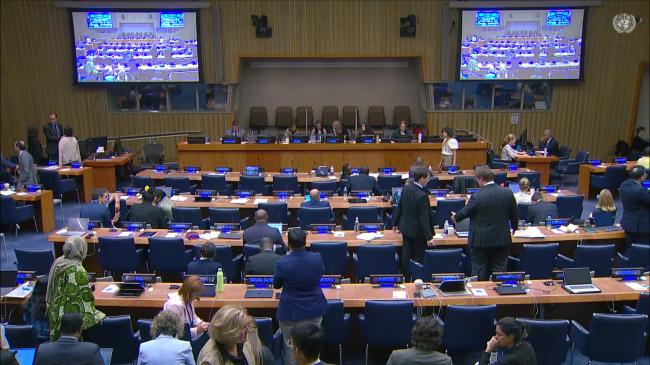
This week, the United Nations headquarters in New York hosted the resumption of the preparatory committee negotiations for the Northwest Atlantic Oceans Convention, as part of efforts to lay the first practical foundations for implementing the High Seas Treaty (BBNJ). Activists, scientists, and representatives of indigenous communities, alongside Greenpeace, called on governments to agree on a process for establishing marine protected areas under this historic treaty, which is expected to enter into force in the coming months following a series of national ratifications.
The treaty, reached after years of negotiation, is a pivotal tool to achieve the global goal of protecting 30% of the oceans by 2030—a commitment adopted by countries under the framework of COP15 on biodiversity.
Voices from the Global South: Capacity Building as a Priority
Professor Babajide Alow, scientific advisor and lead negotiator for the BBNJ treaty from Nigeria, emphasized that “the science is clear: marine protected areas are a crucial tool for preserving biodiversity and ensuring food security for billions of people.” He stressed that Africa, with its vast coastal and marine ecosystems such as the Gulf of Guinea and the Red Sea, needs to strengthen the role of its local scientists.
He noted that capacity building and technology transfer are key pillars for ensuring genuine environmental justice and reducing dependence on external experts.
Calling for Environmental Justice Rooted in Local Knowledge
Noelle Young, environmental justice delegate from Bermuda, called for the Sargasso Sea to become one of the first marine areas protected under the treaty. She stated, “Everything we are in Bermuda is closely linked to the health of this unique oceanic system.”
She urged that Bermuda and other islands be empowered to play a leading role in managing marine protected areas, combining scientific and traditional knowledge, and involving local communities in decision-making.
Greenpeace: No “Paper Parks”
Megan Randles, head of the Greenpeace delegation in the United Kingdom, warned that the treaty could remain mere words on paper if strict mechanisms were not put in place to regulate destructive human activities such as industrial fishing and deep-sea mining.
She said, “Governments have the opportunity to overcome years of stalemate and turn the treaty into a revolution in ocean governance, rather than just a declaration of intent.”
Analytical Perspective: Between Ambition and Implementation
Despite positive momentum, these talks reveal three main challenges. First, the North-South gap: without genuine mechanisms for capacity building and technology transfer, ocean management could remain dependent on Western expertise, reinforcing reliance rather than autonomy. Second, the recognition of traditional knowledge by integrating the voices of local and indigenous communities, as Bermuda has demanded, is essential for achieving true environmental justice. Third, political will and high seas governance remain critical, as disagreements persist over the sharing of responsibilities and authority in areas beyond national jurisdiction.
The success of the BBNJ treaty will depend on its ability to bring about tangible change in high seas management, balancing biodiversity protection with the rights of communities historically linked to the oceans. While the world awaits the treaty’s entry into force, the greatest challenge lies in translating environmental ambitions into practical actions that can shape the future of the oceans.