Mohammed TAFRAOUTI
The International Foundation for Peace and Sustainable Development, in coordination with Moulay Ismaïl University in Meknes and Mexico’s Autonomous University of Campeche (UACAM), organized an important international virtual seminar on Monday, April 7, 2025, titled: “Sustainable Energies in the Global South: Opportunities and Challenges for Morocco and Mexico.” Experts from both countries analyzed the progress made and the challenges faced in the field of energy transition.
The seminar focused on four strategic pillars: national contexts, strategic projects, legal frameworks, and prospects for South-South cooperation.
Dr. Pascual López, former Director of the Energy Center, opened the seminar by highlighting Mexico’s vast potential in clean energy, while pointing out legislative, infrastructural, and investment challenges. He stated, “It is not enough to change the source of energy; we must also transform the power dynamics that have historically excluded rural communities from energy development.”
Ms. Brillyth Zavala discussed the Isthmus of Tehuantepec and wind projects that have triggered social conflicts. She emphasized that “renewable energy is often presented as inherently positive, without acknowledging the social and environmental impacts it can have when imposed without consultation.” She added that in Mexico, “free, prior, and informed consent is still inadequately implemented. Participation is simulated without real consent.”
Dr. Limam Boussif spoke about the great potential of the Saharan reserves in southern Morocco and the public investments aligned with national and local development needs. Dr. Amina El Mekaoui pointed out the similarities in energy transition initiatives in southern Morocco, particularly in Dakhla and Laâyoune, where there is a significant center for the scientific development of ecosystems. She stated: “The goal is to work with Saharan communities and nomads to preserve their customs, ecosystems, and food traditions, ensuring that new energy developments do not disrupt these lifestyles that are central to local identity.”
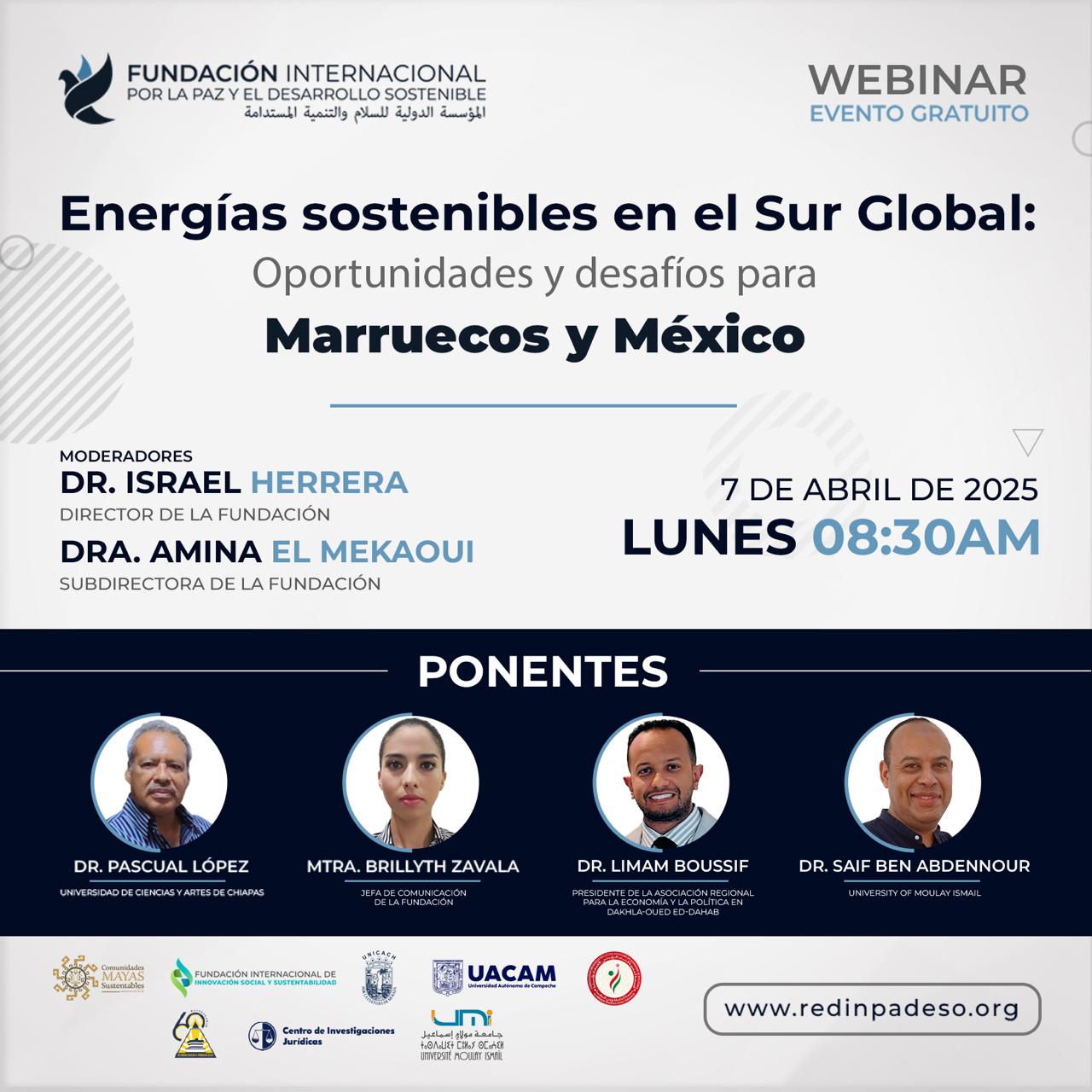
Dr. Saif Ben Abdennour presented the progress achieved in northern Morocco, where significant investments are underway. He stressed that “active and inclusive community participation is essential for genuine sustainable development.”
He also recommended prioritizing a South-South approach rather than a North-South alignment, suggesting the creation of a dynamic for collaboration and exchange of experiences among Southern countries. “Sustainable energies represent a historic opportunity for Global South countries to position themselves as sources of innovation, not just consumers of technology,” he said. Both Morocco and Mexico, he argued, serve as models for countries capable of overcoming challenges through inclusive, fair, and sustainable energy policies. He emphasized the need to support local research into appropriate technologies, ensure inclusive decision-making, create innovative financing mechanisms (green funds, South-South partnerships), and channel part of sustainable energy towards social development (education, healthcare, water, etc.).
Dr. Luis Ramírez Carrillo, a doctor in social sciences and author, remarked that “while land ownership in Morocco is predominantly public, facilitating decision-making, Mexico’s diverse land ownership systems (communal, collective, etc.) make the process more complex.”
Dr. Marcelino García Benítez, from the Institute for Risk Management and Climate Change in Chiapas, added a vital scientific dimension with his expertise in environmental risks. Participants stressed the importance of participatory strategies that meet community needs, and the promotion of education and technological ownership.
Regarding Mexico, participants unanimously acknowledged its promising potential for clean energy investment. However, Dr. El Mekaoui cautioned that “renewable energy in Mexico is multi-dimensional—politically, socially, and economically—and the prevailing neoliberal approach generates land dispossession dynamics, raising concerns about the relationship between ownership and investment.”
All speakers agreed that there is great potential for cooperation between Morocco and Mexico, and that education is key to raising awareness about alternative energies. The webinar was marked by active engagement from the audience.
Speakers emphasized that “initiatives, experience sharing, and forums cannot be dynamic without strengthening bilateral relations between countries that share a long history.” They also stressed the need to launch translation projects between Arabic and Spanish on critical subjects, demonstrating that South-South cooperation can open vast prospects for exchange and joint development in the energy sector.
This gathering provided a valuable opportunity for the cross-fertilization of experiences and ideas, paving the way for academic cooperation between Morocco and Mexico and laying the foundation for future exchanges that can reinforce energy transition strategies in both countries from a comprehensive, sustainable, and community-respectful perspective.
It is worth noting that the webinar saw the participation of several prominent Mexican universities, including UNAM, and institutions from Mazatlán, Colima, Mexico City, and Nayarit, covering fields such as engineering, social sciences, and environmental studies.
The webinar was led by Dr. José Herrera, professor-researcher at the Legal Research Center of the Autonomous University of Campeche and Director of the Foundation, with strong support from Dr. Amina El Mekaoui, Vice Director of the Foundation and researcher in Mexico affiliated with SECIHTI (Secretariat of Science, Humanities, Technology and Innovation). A Moroccan-born Mexican researcher, Dr. El Mekaoui specializes in community energy development projects in southeastern Mexico. Her extensive experience, including holding a scientific chair in Yucatán and leading a PRONAII project under Mexico’s National Strategic Programs, has significantly enriched the scientific dialogue between Morocco and Mexico.
The event brought together a distinguished panel of academics. From the Mexican side, Dr. Pascual López de Paz from the University of Sciences and Arts of Chiapas, and Ms. Brillyth Zavala Ceja from the Autonomous University of Campeche participated. From the Moroccan side, Dr. Limam Boussif, President of the Regional Association for Economy and Policy in the Dakhla-Oued Ed-Dahab region, and Dr. Saif Ben Abdennour from Moulay Ismaïl University contributed their insights.