By mohammed tafraouti
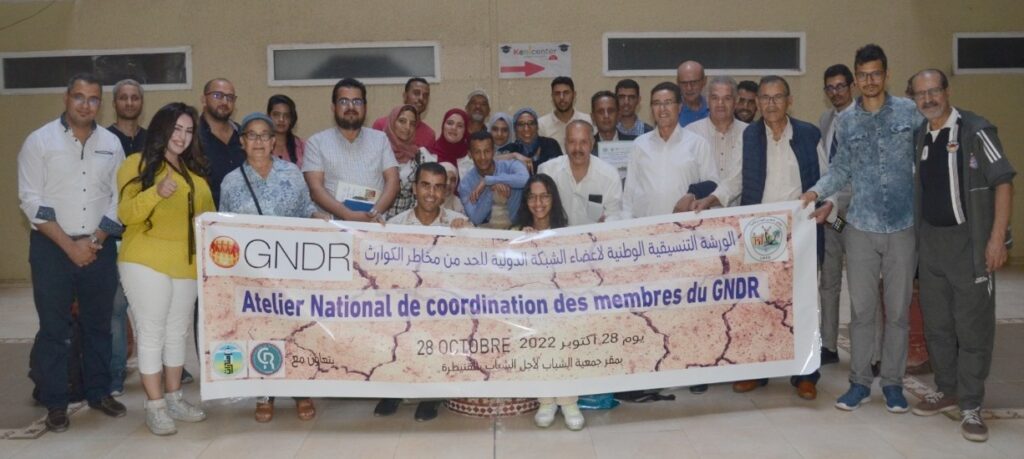
The Moroccan Club for Environment and Development organized, within the framework of the Global
Network of Civil Society Organizations for Disaster Reduction(GNDR) work plan and activities, in
collaboration with the Research and Support Center for the Environment and Sustainable Development
in Kenitra, and the Environmental Lighthouses Association for Development and Climate, a coordination
workshop among members of the global national network on the topic “Climate forecasts
Determination and their role in dealing with disaster risks.”
This workshop, in which many university professors participated, aims to present the “climate
forecasting” approach to address climate risks that relate to disaster risks at the local level, as well as to
review the GNDR climate forecasting guide and toolkit directives in order to agree on the priorities for
the future work of the national branches and to adopt appropriate mechanisms to improve
communication and coordination among the member states of the GNDR. That was also an occasion to
share a comprehensive vision of the GNDR work and invite Moroccan civil society organizations to join.
The workshop was an opportunity to promote members’ capacities in order to better apply the
directives of the Sendai Framework and improve their contribution to disaster risk reduction at the
community level.
During their presentation on “Climate Change and Disaster Risks in Morocco: Facts and Prospects”,
Mohamed El Ateiris and Ahmed Malin Amin showed the disturbing trend of phenomena related to
disaster risk and climate change in Morocco, such as irregular rainfall and decline, frequent droughts,
and increasing temperatures, extreme climate events such as heat waves and rainstorms and strong
winds, decline, and degradation of vegetation, atmospheric pollution, and creeping locust waves. Then
extreme events associated with climate change such as floods, tsunamis, soil erosion, and mudslides.
Morocco’s efforts to adapt to climate change were reviewed, at different levels: governance
improvement, resilience and coping capacity at the community and population level, voluntary
commitment to reduce greenhouse gases -17 percent reduction by 2030-, as well as measures to energy
transformation and efficiency – transition to solar and wind energy by 52 percent by 2030-. It was
noticed that adaptation and mitigation measures for climate change and disaster risk prevention should
be integrated into territorial development plans(PAC, PDR). In the end, an overview of the National
Strategy for Disaster Risk Reduction 2020-2030 was shared, in addition to the Arab Strategy for Disaster
Risk Reduction for the period 2015-2030.
Professors Mohamed Fatouhi and Issa Al-Bouzidi approached climate forecasts and disaster risk
reduction at the local level, focusing on the content of the reference guide prepared by the GNDR. The
context and emergence of the “climate projections” approach and its relationship to the disaster risk
reduction approaches were presented, based on the content of the GNDR guide and tools related to the
roles of local actors, in order to prevent the causes of climate change and disaster risks, by adopting a
comprehensive and participatory approach.
Researchers defined the different concepts: the structural concepts of disaster risk, the local actor,
climate prediction, and the classification and mapping of disaster risks with the local community.
Examples were given about the risks of man-made natural disasters and climate change, armed
conflicts, gender inequality, damage to food and water security, uncontrolled urbanization, and forced
migration caused by climate change and disasters. The “climate forecast and projection” approach was
highlighted to involve local communities, along with scientists, in the process of disaster risk prevention
and reduction. The steps for applying the approach was explained to the actors as described in the guide
of the GNDR. The intervention was followed by a practical exercise on how to apply the “climate
forecasting” approach in a local community exposed to disaster risks.
After the theoretical and practical presentations, the participants discussed a set of ideas and
perceptions that were mentioned in the presentations. They also discussed the priorities of the action
plan and cooperation between the national members of the GNDR. The participants recommended to
improve communication between members, through programming and implementing interactive
meetings and exchange of experiences and training directly or remotely.
Participants also called to increase awareness and education regarding disaster risk reduction. they also
suggested to use modern and traditional knowledge to promote warning, preparedness and prevention
of disaster risks in order to support NGOs with the knowledge and skills that enable them to monitor
and evaluate policies and strategies related to disaster risk reduction at the local and national levels.
“Climate forecasting” approach should be seen as an opportunity to combine local with scientific
knowledge to better manage and reduce disaster risks and minimize impacts of climate change. This
will facilitate the integration of the “climate change and disaster risk” prevention dimension into local
and national development strategies and plans.
Participants recommended that the National Strategy for Disaster Risk Management (2020-2030) and
the Sendai Framework for Disaster Risk Reduction 2015-2030 should be adequately communicated
among civil society organizations and local actors. Moroccan NGOs membership in the GNDR should be
expanded, and then promote more partnerships with the administrative authorities, meteorological
services, academics, elected officials, media and the private sector. And improving internal
communication between the network’s national members through periodic meetings according to an
annual program, with specific goals, inspired by the network’s priorities and the national strategy for
disaster risk reduction. Scientific research in the areas of prevention and early warning to reduce
disaster risks should be encouraged. Enhancing collaboration with the media will inform about the
approach “setting climate expectations” and applying the GNDR guide to promoting a culture of disaster
risk reduction more broadly.
At the end, the forum appointed an ad-hoc committee to follow up the recommendations of the
workshop, and to prepare for the next edition that will focus on the design of an action plan for the
members of the GNDR in Morocco..