Bank Al-Maghrib, Morocco’s central bank, has signed a cooperation agreement with the European Investment Bank (EIB) aimed at helping the Moroccan financial sector manage climate-related risks and channel more money into green investment. The agreement was signed in Rabat on Friday, November 20.
Technical Support for Climate Supervision
Under the deal, EIB Global, the bank’s arm for operations outside the European Union, will provide technical assistance to Bank Al-Maghrib through its advisory services. The support will focus on strengthening the central bank’s regulatory and supervisory framework for climate risks, including risk assessment tools and climate stress tests, as well as training for its staff.
The programme will also include exchanges with European central banks and supervisors, with the aim of bringing Moroccan prudential practices closer to international standards while taking account of the specific features of the national banking system.
The agreement was signed by Bank Al-Maghrib Governor Abdellatif Jouahri and Adrien de Bassompierre, head of the EIB’s representation in Morocco, in the presence of Stefan Bantle, chargé d’affaires at the German Embassy.
Part of a Wider International Programme
The cooperation falls under the Greening Financial Systems (GFS) technical assistance programme, financed by Germany and Luxembourg through a dedicated fund and coordinated with the NDC Partnership. The programme helps central banks, regulators and financial institutions assess climate risks and create conditions that encourage sustainable investment.
Morocco joins a group of beneficiary countries that includes Albania, Armenia, Bosnia and Herzegovina, Ethiopia, Georgia, Jordan, Kenya, North Macedonia, Nigeria, Rwanda, Uganda and Vietnam.
Officials Stress Resilience and Investment
Jouahri said the central bank had started integrating climate risks into banking supervision “at an early stage,” and that the partnership would help it align its tools with the highest international standards.
De Bassompierre said a successful green transition requires a financial sector able both to manage climate risks and to direct investment towards sustainable activities. He added that the cooperation should help Moroccan lenders better support businesses, particularly small and medium-sized enterprises.
Bantle noted that Germany and Morocco have cooperated on climate protection for more than a decade, describing the shared goal as making financial systems more resilient to climate shocks.
The agreement comes as Morocco, which faces recurrent drought and water stress, seeks to mobilise finance for its energy transition and climate adaptation goals.
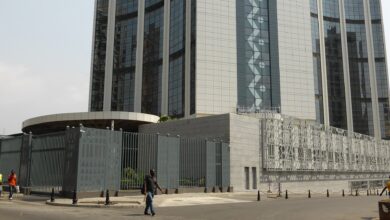
The headquarters of Bank Al-Maghrib, Morocco’s central bank, in Rabat (file photo). Photo: Boubloub / Wikimedia Commons, CC BY-SA 4.0 (source).